For years, Oracle customers across the UAE, Bahrain, Kuwait, Qatar, and KSA operated under one quiet assumption: that the Gulf region was stable enough to trust with a single-region deployment. That assumption is now outdated.
Regional uncertainty, cyber threats, regulatory mandates, and the sheer complexity of modern Oracle Cloud environments have fundamentally changed the calculus of disaster recovery planning. Whether your organization runs Oracle EBS on-premises, Oracle Fusion in the cloud, or a layered OCI environment spanning Compute, Integration Cloud, Autonomous Database, and APEX. The question is no longer if disruption will occur. It is whether your Oracle disaster recovery strategy can absorb it.
This guide covers everything Gulf enterprises need to know about Oracle Cloud disaster recovery: what is at risk, what the solution looks like, how to choose the right DR tier, and what realistic RTO/RPO targets look like, so you can make an informed decision before a crisis makes it for you.
What Is Oracle Cloud Disaster Recovery and Why Does It Matter for Gulf Enterprises?
Oracle Cloud disaster recovery (DR) is the practice of maintaining a pre-configured, continuously synchronized replica of your Oracle production environment in a geographically separate OCI region. When your primary region becomes unavailable, whether due to a regional outage, a cyber-attack, a connectivity failure, or any other disruption and your business fails over to the DR environment and continues operating.
For Gulf-based organizations, this is not an abstract exercise. Single-region OCI deployments regardless of how well-architected they are within that region offer zero protection against a regional event. And a backup that lives in the same region as your production environment is not a backup. It is a copy of something you may not be able to reach when you need it most.
Why Oracle Disaster Recovery Is Critical for UAE and GCC Businesses
Gulf enterprises face a convergence of pressures that make Oracle disaster recovery not just advisable, but essential:
- Geopolitical and regional instability requiring business continuity planning outside the Gulf corridor
- Regulatory mandates from CBUAE, SCA, DHA, and other Gulf regulators requiring documented RTO/RPO compliance
- Increasing cyber threat exposure making ransomware and attack-related outage a board-level risk
- Oracle workload complexity where a gap in one layer (OIC, APEX, WebLogic) renders the entire ERP effectively unusable even if the database survives.
What Is Actually at Risk Without Oracle Disaster Recovery?
If your Oracle EBS, Fusion, or OCI workloads are housed exclusively in a UAE or Gulf data center with no cross-region disaster recovery configured, a regional disruption produces a very specific chain of failures:
What a regional Oracle outage looks like in practice:
- Finance cannot close the month. AP/AR approvals freeze. Supplier payments stop. Bank reconciliations become impossible.
- Supply chain halts. Order processing, GRN updates, and inventory adjustments cannot proceed. Customer commitments are missing.
- Integrations go silent. OIC flows, VBCS applications, and custom APIs stop. Partner and customer-facing systems lose connectivity.
- HR and Payroll freeze. Leave requests, salary runs, and employee self-service become inaccessible during the outage window.
- IT has no recovery path. Without a tested DR runbook or standby environment, the team is building under pressure — extending every minute of downtime.
This is not a technology failure. It is a planning failure and one which is entirely preventable with a properly designed Oracle Cloud disaster recovery architecture.
The Three Risk Dimensions Driving Oracle DR Urgency in the Gulf
1. Geopolitical and Regional Instability
Increasing regional uncertainty is forcing enterprises to plan business continuity entirely outside the Gulf corridor. Single-region OCI deployments regardless of their internal redundancy offer no protection against a region-level event. The appropriate response is cross-region Oracle disaster recovery, not enhanced single-region resilience.
2. Regulatory and Compliance Pressure
Financial services, healthcare, and government entities across the Gulf now face mandates to maintain documented data availability and recovery capabilities with defined RTO/RPO targets. Many Gulf regulatory frameworks require recovery within four hours or less. Organisations that cannot demonstrate a tested, documented Oracle disaster recovery plan are not just operationally exposed, they are potentially non-compliant.
Key regulatory drivers for Oracle disaster recovery compliance in the Gulf:
- CBUAE and SCA mandates for financial services business continuity
- DHA (Dubai Health Authority) data availability requirements
- Abu Dhabi ADGM and DIFC regulatory frameworks
- GCC government entity internal audit and digital resilience requirements
- ISO 22301 Business Continuity certification requirements for enterprise procurement
3. Oracle Workload Complexity
OCI environments are not monolithic. They are layered stacks. Consider Oracle Database, Compute VMs, Oracle Integration Cloud, WebLogic, VBCS, APEX, OAC, Object Storage, WAF, and more. A disaster recovery gap in any single layer puts the entire business process at risk. You may have your Oracle Database protected with Data Guard, but if your Oracle Integration Cloud environment has no failover configuration, your ERP is effectively down even when the data is intact.
This is why complete Oracle disaster recovery requires layer-by-layer coverage and not just database replication.
The Solution: Cross-Region OCI Disaster Recovery for Oracle Workloads
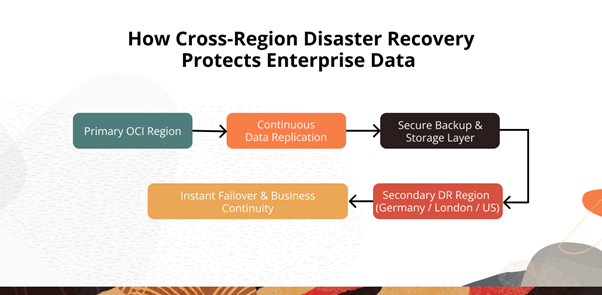
Oracle Cloud Infrastructure gives Gulf enterprises architecture to solve this completely. The answer is cross-region Oracle disaster recovery which is a mirrored, pre-configured standby environment in a geographically separate OCI region that is continuously synchronized with your primary Gulf deployment.
When something goes wrong in your primary region whether it is a connectivity disruption, a cyber-attack, or a natural disaster, your business switches over to the DR region and continues operating. Not tomorrow. Not after a week of emergency rebuild work. Within hours, or less, depending on your chosen DR tier.
What cross-region Oracle disaster recovery gives you:
- Geographic separation: Your standby environment is in a completely different OCI region like Frankfurt, London, Ashburn, or Phoenix
- Continuous synchronisation: Oracle Data Guard replicates your database at near-zero RPO and recovery point measured in seconds, not hours
- Full-stack coverage: Database, Compute, OIC, APEX, WebLogic, Object Storage, WAF — every layer protected
- Tested recovery: A DR environment that has never been drilled is not a DR environment. It is a hope.
- Compliance documentation: Signed-off RTO/RPO evidence ready for regulatory and audit review at any time
Best DR Destination Regions for Gulf Oracle Customers
Conneqtion recommends four OCI regions as Oracle disaster recovery destinations for Gulf-based enterprises. Each offers meaningful geographic separation, enterprise-grade infrastructure, and full OCI service parity:
Frankfurt, Germany — GDPR-Compliant European DR
GDPR-compliant, Tier IV infrastructure, and EU regulatory safe harbour. The preferred choice for organisations with European business relationships, data residency obligations, or financial services regulatory requirements. Excellent connectivity latency from GCC to Central Europe makes Frankfurt the most commonly selected DR region for Gulf Oracle customers.
London, United Kingdom — Financial Services DR Hub
Strong financial services infrastructure, UK data residency compliance, and deep connectivity to Gulf business hubs through existing SWIFT, banking, and trade corridors. A familiar jurisdiction for Gulf-headquartered multinationals with UK-regulated entities or investment operations.
Ashburn, Virginia, USA — North American Enterprise DR
One of the world’s highest-density data centre markets. Optimal for organisations with North American operations, US-based stakeholders, or global enterprise applications requiring east-coast US proximity. Excellent Oracle Cloud infrastructure density and SLA reliability.
Phoenix, Arizona, USA — Inland US DR with Climate Resilience
Inland location reduces coastal and climate risk exposure. A strong option for organisations seeking a second US-region backup or wanting geographic separation from Ashburn within the same continental infrastructure. Increasingly selected for its resilience profile and competitive OCI pricing.
Two Oracle Disaster Recovery Tiers — Choose What Fits
Not every workload demands the same level of DR investment, and not every organisation has the same risk tolerance. Conneqtion structures Oracle disaster recovery into two clearly defined tiers:
For organisations where downtime is measured in revenue per minute.
A full mirror of your production environment running in standby in the DR region, with Oracle
Data Guard delivering continuous database replication at near-zero RPO.
- RTO: Under 1 hour
- RPO: Under 15 minutes (database RPO ~10 seconds with Oracle Data Guard)
- Compute: Full standby VMs pre-provisioned and running in DR region
- Failover: Automated DNS switchover — minimal manual intervention required
- Implementation: 8–12 weeks
- Best for: Mission-critical Oracle ERP, real-time production systems, financial operations, regulated entities
For organisations that need resilience without full standby infrastructure costs.
A reduced-footprint standby environment that is pre-configured and replication-ready, but only
fully activated on failover. You get Oracle Data Guard’s near-zero database RPO without paying
for full-scale standby compute.
- RTO: 2–4 hours
- RPO: 1–4 hours (database RPO ~10 seconds with Oracle Data Guard)
- Compute: Minimum-OCPU standby with OCI block volume replication
- Failover: Manual switchover with pre-defined runbook
- Implementation: 4–6 weeks
- Best for: Cost-optimised resilience, secondary workloads, non-real-time systems
At a glance — which Oracle DR tier is right for you?
| Full Scale DR — Option A | Downscale DR — Option B |
|---|---|
| RTO: Under 1 hour | RTO: 2–4 hours |
| RPO: < 15 minutes | RPO: 1–4 hours |
| Database RPO: ~10 seconds | Database RPO: ~10 seconds |
| Compute: Full standby running | Compute: Minimum-OCPU standby |
| Failover: Automated | Failover: Manual with runbook |
| Cost profile: Higher | Cost profile: Optimised |
| Timeline: 8–12 weeks | Timeline: 4–6 weeks |
| Best for: Mission-critical ERP | Best for: Secondary/non-RT systems |
Full Oracle Stack Coverage — No Layer Left Unprotected
One of the most common Oracle disaster recovery failures is partial coverage where the database is protected, but the integrations are not. The compute is replicated, but the OCI configuration is undocumented. Conneqtion’s Oracle DR service covers every layer:
1) Oracle Database and Core Data Services
Oracle Database replication via Oracle Data Guard with continuous synchronisation. Autonomous Data Warehouse (ADW), Exadata Cloud Customer, DBaaS, ATP, ADW, and MySQL all covered with cross-region standby configuration and documented recovery procedures.
2) OCI Compute Instances
Boot volume and block volume backup policies with configurable frequency from hourly to weekly depending on criticality tier. Full standby VM provisioning in the DR region with documented restoration procedures and recovery time validation.
3) Oracle Integration Cloud, WebLogic, APEX, and Application Services
Scheduled OIC integration exports, environment configuration backup, and full artifact replication to the DR region. WebLogic, VBCS, Oracle APEX, OAC, ODI, ADF, and OCI Functions. This is the layer most DR plans miss and the one that determines whether your ERP actually works after failover.
4) Oracle EBS (On-Premises and OCI-Hosted)
Database replication to OCI with application recovery processes for both on-premises Oracle EBS and EBS running on OCI. Backup to OCI Object Storage with defined retention policies and tested recovery procedures.
5) OCI Infrastructure and Network Configuration
Export of OCI networking, IAM, security rules, compartments, load balancer config, and all infrastructure settings for rapid reconstruction in the DR region. This is the safety net most Oracle customers do not realise they are missing until they need it.
6) Cyber-Attack Resilience and Security Configuration
WAF and OCI Network Firewall configuration backup ensuring your security posture is fully recoverable in the event of an attack, not just a regional disruption. Critical for organisations that face both uptime and cyber resilience regulatory requirements.
Oracle DR RTO/RPO Reference — Real Numbers, Not Marketing Estimates
The following recovery time and recovery point objectives are aligned with Oracle MAA (Maximum Availability Architecture) documentation. These are engineering-verified figures, not aspirational claims:
| Oracle Component | Full DR — RTO | Full DR — RPO | Downscale — RTO | Downscale — RPO |
|---|---|---|---|---|
| Oracle Database (Data Guard) | ~2 minutes | ~10 seconds | ~2 minutes | ~10 seconds |
| Autonomous Data Warehouse | < 10 minutes | ~1 minute | < 10 minutes | ~1 minute |
| Virtual Machines (Full Standby) | 5–10 minutes | < 30 minutes | 30–45 minutes | < 30 minutes |
| Block Volumes (Replication) | < 1 minute | < 30 minutes | < 1 minute | < 30 minutes |
| File Systems (Cross-Region FSS) | < 5 minutes | ≥ 15 minutes | < 5 minutes | ≥ 15 minutes |
| Object Storage (Cross-Region) | Minutes | < 5 minutes | Minutes | < 5 minutes |
| OIC / WebLogic / VBCS / APEX | 2–3 hours | < 30 min–Daily | 3–4 hours | Weekly–Daily |
Oracle DR Implementation Methodology — Four Phases, No Steps Skipped
A structured, layer-by-layer approach is critical for Oracle disaster recovery implementations. Here is the proven methodology Conneqtion uses for Gulf-region Oracle customers:
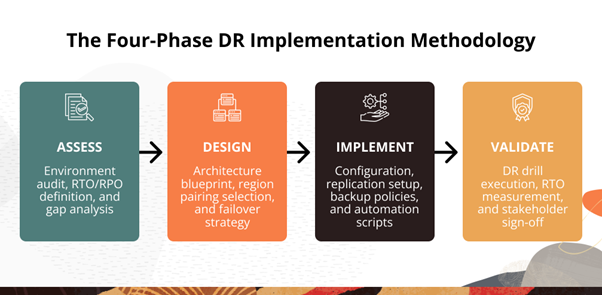
A DR setup that has never been drilled is not a DR setup. It is hope. Every Conneqtion Oracle DR implementation includes a validated DR drill with measured RTO before sign-off.
Why an Oracle-Only Partner Changes Oracle DR Outcomes
There are dozens of technology partners operating in the Gulf. Most of them work across AWS, Azure, OCI, and GCP simultaneously splitting their attention, their expertise, and their methodology across competing platforms.
Conneqtion is different in one fundamental way: we only do Oracle.
Every consultant we employ. Every methodology we use. Every Oracle DR implementation we have delivered. It is all Oracle. OCI, Fusion, EBS, Data Guard, Oracle Integration Cloud, APEX, Autonomous Database, these are not services we offer alongside other things. They are the only things we do.
When you need a team that can assess your OCI environment, design a cross-region Oracle disaster recovery architecture, and begin implementation within days you want the team that has done it before. Repeatedly. Right now, for Gulf customers in exactly your situation.
What Oracle-exclusive focus means for your DR engagement:
- Our team recognises Oracle EBS and Fusion integration complexity that generalist partners miss
- Our Oracle Data Guard expertise means correct configuration, not best-effort approximation
- Our OIC and APEX DR experience covers the application layer gaps that cause most post-failover failures
- Our Gulf-region track record means we know how regional OCI infrastructure behaves under pressure
- Our outcome-based model means we are accountable for your actual RTO — not an SoW deliverable
The Cost of Waiting
Most organizations underestimate the real cost of not having a Disaster Recovery strategy until they experience it.
Now consider this:
- What happens if your Oracle ERP is unavailable for even a few hours?
- Can your finance team close books?
- Can your operations continue without system access?
- Can your business afford delays in payments, orders, or compliance reporting?
For most mid-sized and large enterprises, even a single day of downtime can result in:
- Significant revenue loss
- Operational disruption across departments
- Regulatory and compliance exposure
- Long-term reputational damage
A robust cross-region DR setup requires planning, architecture, and validation. It cannot be rushed when systems are already down.
Organizations that recover quickly are not the ones reacting in real time, but they are the ones who prepared in advance.
Frequently Asked Questions — Oracle Disaster Recovery
1.What is the difference between Oracle backup and Oracle disaster recovery?
Oracle backup creates point-in-time copies of your data for restoration. Oracle disaster recovery (DR) is a broader architecture that includes a continuously synchronised standby environment, pre-defined failover procedures, and a tested recovery path. Backup answers the question: can I restore my data? Disaster recovery answers the question: can my business continue operating after a major disruption?
2.What is RTO and RPO in Oracle Cloud disaster recovery?
RTO (Recovery Time Objective) is the maximum acceptable duration of downtime and how quickly your Oracle system must be back online. RPO (Recovery Point Objective) is the maximum acceptable data loss, how far back in time you can afford to recover to. Oracle Data Guard can deliver database RPO of approximately 10 seconds. Full application RTO depends on your DR tier and architecture from under 1 hour for Full Scale DR to 2–4 hours for Downscale DR.
3.How does Oracle Data Guard work for cross-region disaster recovery?
Oracle Data Guard maintains a synchronised standby database in a separate OCI region. Changes applied to the primary database are continuously transmitted to and applied on the standby. In the event of a primary region failure, the standby is promoted to primary and operations resume with minimal data loss. Data Guard is the foundation of every Oracle Database DR configuration and delivers the lowest achievable RPO for Oracle workloads.
4.Can Oracle EBS disaster recovery be configured on OCI without disrupting production?
Yes. Cross-region Oracle EBS disaster recovery is configured through non-disruptive, API-level integration with your existing EBS environment. No changes are made to production schemas or core EBS configurations. Replication is implemented at the database and storage layer, and standby compute is provisioned independently in the DR region. Production runs unaffected throughout implementation and testing.
5.What Oracle workloads should be included in a Gulf enterprise DR plan?
A complete Oracle disaster recovery plan for a Gulf enterprise should cover: Oracle Database (via Data Guard), Autonomous Database, OCI Compute instances, Oracle Integration Cloud (OIC), Oracle APEX, WebLogic, VBCS, OCI Object Storage, OCI Networking and IAM configuration, WAF, and any on-premises Oracle EBS components. Protecting the database alone is insufficient, the application layer must be included for the ERP to function after failover.
Take the First Step Toward Resilience
If you are unsure whether your current Oracle environment can withstand a real disruption, this is the right time to assess it.
At Conneqtion Group, we help Oracle customers move from uncertainty to clarity quickly and practically.
 |
In a focused 30-minute conversation with a senior Conneqtion Oracle architect, we will:
- Evaluate your current Oracle disaster recovery readiness across all workload layers
- Identify critical DR gaps in your OCI, EBS, Fusion, or on-premises Oracle environment
- Align your environment with realistic, Oracle MAA-documented RTO/RPO expectations
- Recommend a tailored cross-region DR approach (Full Scale or Downscale, with indicative timelines)
- Provide a written DR Gap Summary as a follow-up, at no cost
Contact us: [email protected]