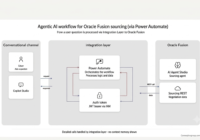
Procurement software has been sold on the same promise for years: bring every requisition, negotiation, and supplier response into one system, and sourcing will finally run smoothly. In practice, sourcing and category managers still spend a large part of their day doing the opposite of what that promise implies. They move between negotiation screens, chase suppliers for missing responses, and manually work out which deal needs attention today and which one can wait.
A category manager handling twenty or thirty live negotiations across categories such as IT hardware, packaging, or life sciences cannot realistically track every closing date, every supplier response, and every approval that is stuck in someone’s queue. Sourcing events pile up quietly in the background, and by the time a negotiation is flagged as a problem, it is often already late.
Award decisions add another layer of manual effort. Comparing supplier bids on price, compliance, delivery terms, and technical fit usually means opening several documents side by side, tallying scores by hand, and hoping nothing was missed. It is slow, and it does not scale well when procurement volumes grow.
The Gap Between Having Fusion Procurement Data and Getting Actionable Answers
Most organisations running Oracle Fusion Cloud Procurement already have the data problem solved on paper. Every negotiation, every RFQ, every supplier response, and every award decision is captured and stored centrally. The system knows exactly how many negotiations are open, which ones are closing soon, and which suppliers have responded.
The problem is that knowing where the data lives is not the same as knowing what it means right now. To answer something as basic as “which negotiations need my attention today“, a sourcing manager still must open Manage Negotiations, apply filters, and scroll through a list. To compare supplier bids, they still export or eyeball response after response. The information is sitting inside Fusion, but pulling out a decision-ready answer is manual work every single time.
This is the gap the Sourcing Command Center is built to close, by putting AI agents on top of that existing Fusion data instead of asking sourcing teams to keep digging for it themselves.
How the Sourcing Command Center Works
The Sourcing Command Center is an agentic AI application built natively on Oracle Fusion Cloud Procurement. Instead of replacing the negotiations and RFQ processes sourcing teams already use, it sits on top of them. A set of specialised AI agents continuously reads negotiation status, supplier participation, response volumes, and award readiness, then surfaces what needs a decision on a single workspace.
Rather than a category manager opening each negotiation to check its status, the app does that work in the background and brings forward only what matters: negotiations that are closing soon with low participation, approvals that are stuck, or awards that are overdue. When a decision is needed, the same workspace lets the manager ask a question in natural language, get a supplier recommendation with the reasoning behind it, and apply an award without leaving the screen.
Core Capabilities: Driving Efficiency Across the Procurement Lifecycle
- AI-Generated Insights: The workspace opens with a narrative summary written in plain language rather than a wall of charts. It calls out patterns such as negotiations with low supplier participation, approvals pending too long, or negotiations that closed without an award decision, so the manager knows where to look before opening a single negotiation.
- Priority Actions: This panel lists the specific negotiations and RFQs that need a decision right away, each one tied to a recommended action, such as applying a recommended award or reviewing a negotiation before its award date passes. Actions that could easily be missed inside a long list of open negotiations are surfaced here instead.
- Workload Overview: A negotiation status table shows how many negotiations are active, in draft, or pending award, along with how many in each status need attention. It gives a category manager an honest read of their workload without having to run a custom search.
- Ask Oracle Bar: Sourcing managers can ask questions, such as asking about a specific RFQ, and the app’s NL2SQL capability interprets the request and routes it to the right agent. There is no need to build a filter or remember where a particular report lives.
- Negotiation Snapshot: For any negotiation, the app returns a structured, explainable answer covering how many suppliers were invited, how many responded, and which response currently leads on price, along with the reasoning behind that read. What used to take a manual review of every response is available in seconds.
- Supplier Recommendation and Comparison: Where a deeper evaluation is needed, the app connects to Supplier Seleqt, Conneqtion’s supplier evaluation layer, to generate a full vendor comparison report scoring each supplier on technical fit, commercial terms, and compliance, with a clear recommended vendor and the reasoning for that recommendation.
- One-Click Award Application: Once a recommendation is accepted, the award can be applied directly from the Command Center, whether that is a sole source award to the best overall response or a maximum savings award split across suppliers by line. The negotiation moves to Award in Progress without a separate manual entry step.
A Morning in the Life of a Sourcing Manager
The easiest way to see how the Sourcing Command Center changes a sourcing manager’s day is to walk through it the way it happens. Meet Zara, a category manager responsible for a mix of negotiations spanning IT hardware, packaging, and lab supplies. Here is what a typical morning looks like once the Sourcing Command Center is part of her Fusion Procurement environment.
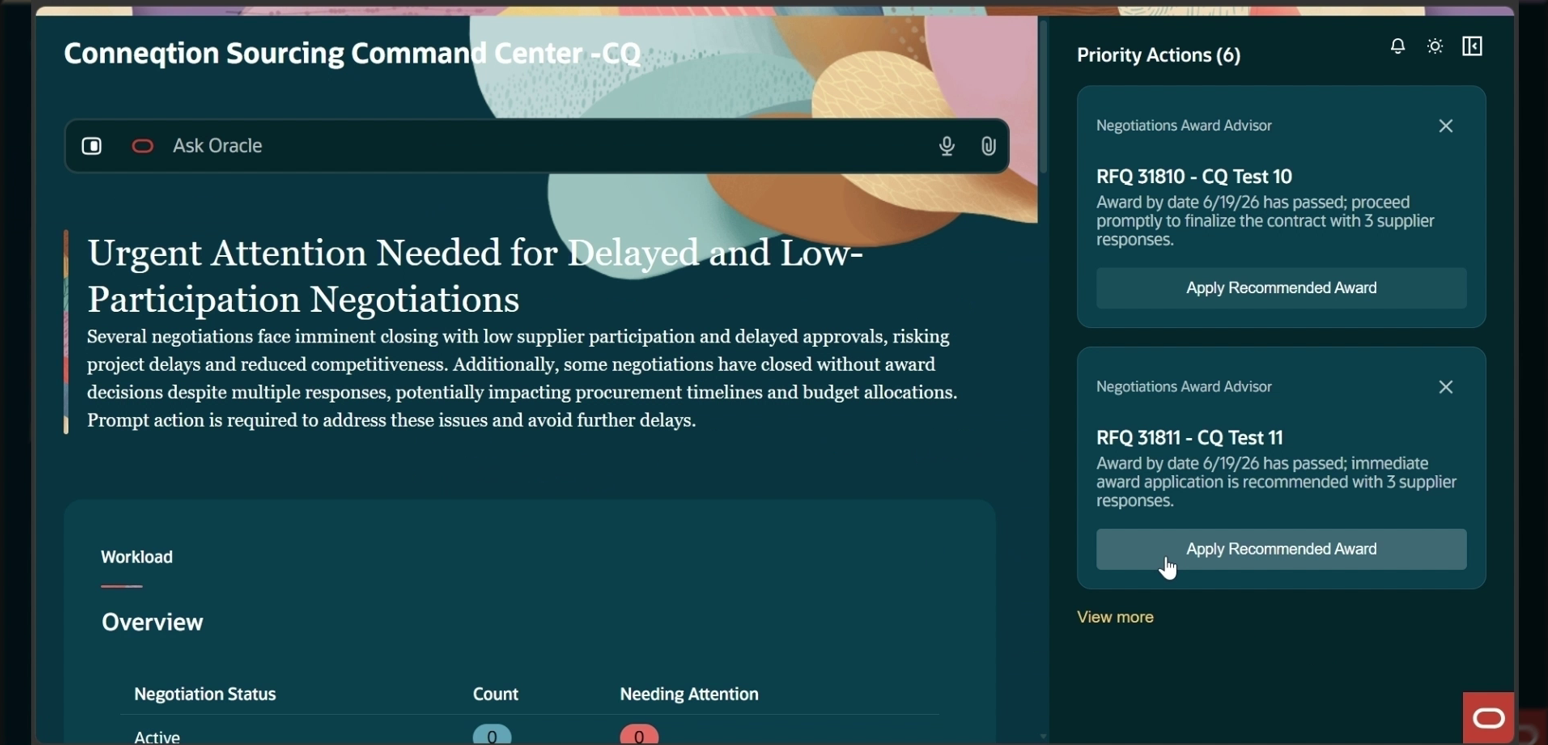 Zara’s workspace opens with an AI-generated insight, a workload overview, and Priority Actions on a single screen.
Instead of opening Manage Negotiations and running a search, Zara lands on a workspace that has already done that work for her. An AI-generated insight at the top flags that several negotiations are closing with low supplier participation, and some have already closed without an award decision. Below it, a workload overview breaks her active negotiations down by status, and a Priority Actions panel on the right lists the negotiations that need her attention first, each with a one-click recommended action such as applying an award.
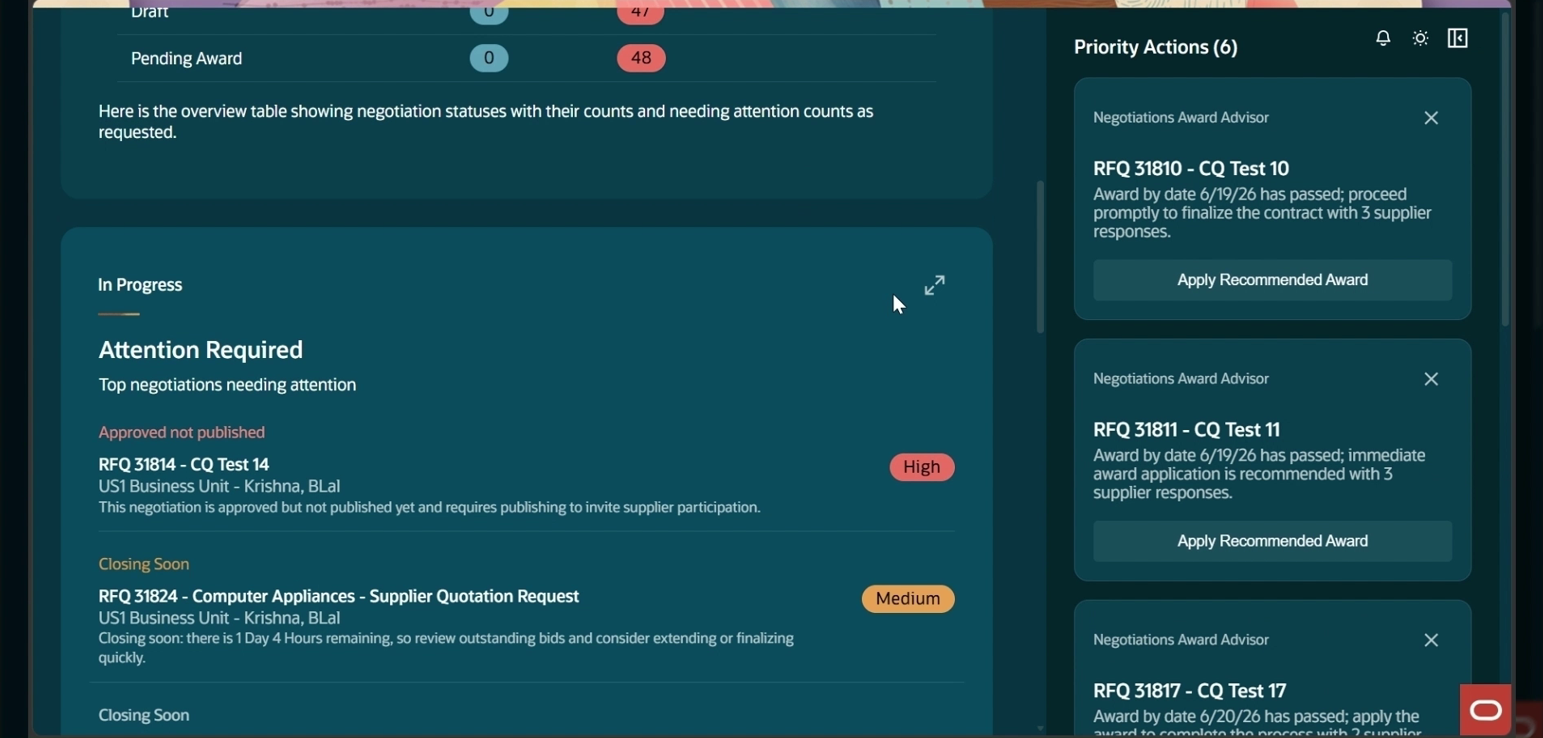 The workspace flags RFQ 31824 – Computer Appliances as closing soon, alongside other negotiations needing attention.
Scrolling down, an Attention Required list ranks her negotiations by urgency. One entry catches her eye: RFQ 31824, a Computer Appliances – Supplier Quotation Request, tagged Medium and closing in a little over a day. Rather than digging through her full negotiation list to find it, the app has already picked it out and explained why it needs a decision soon.
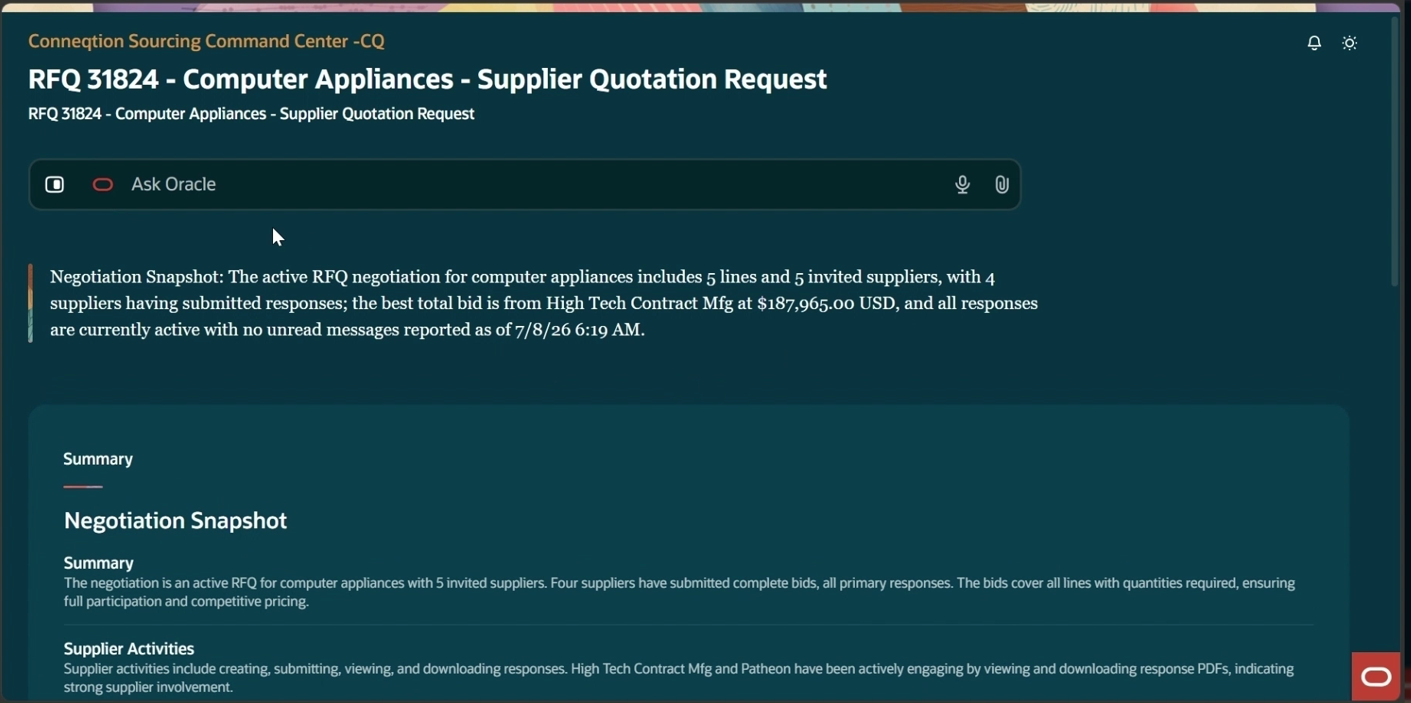 Opening the negotiation, the app returns an AI-generated snapshot summarizing supplier, responses, and the current best bid.
Zara opens RFQ 31824 directly from the insight. Instead of a blank negotiation screen, the app greets her with a Negotiation Snapshot: five suppliers were invited, four have submitted complete responses, and the strongest bid so far comes from High Tech Contract Mfg. It also confirms there are no unread supplier messages, so nothing is waiting on her before she moves forward.
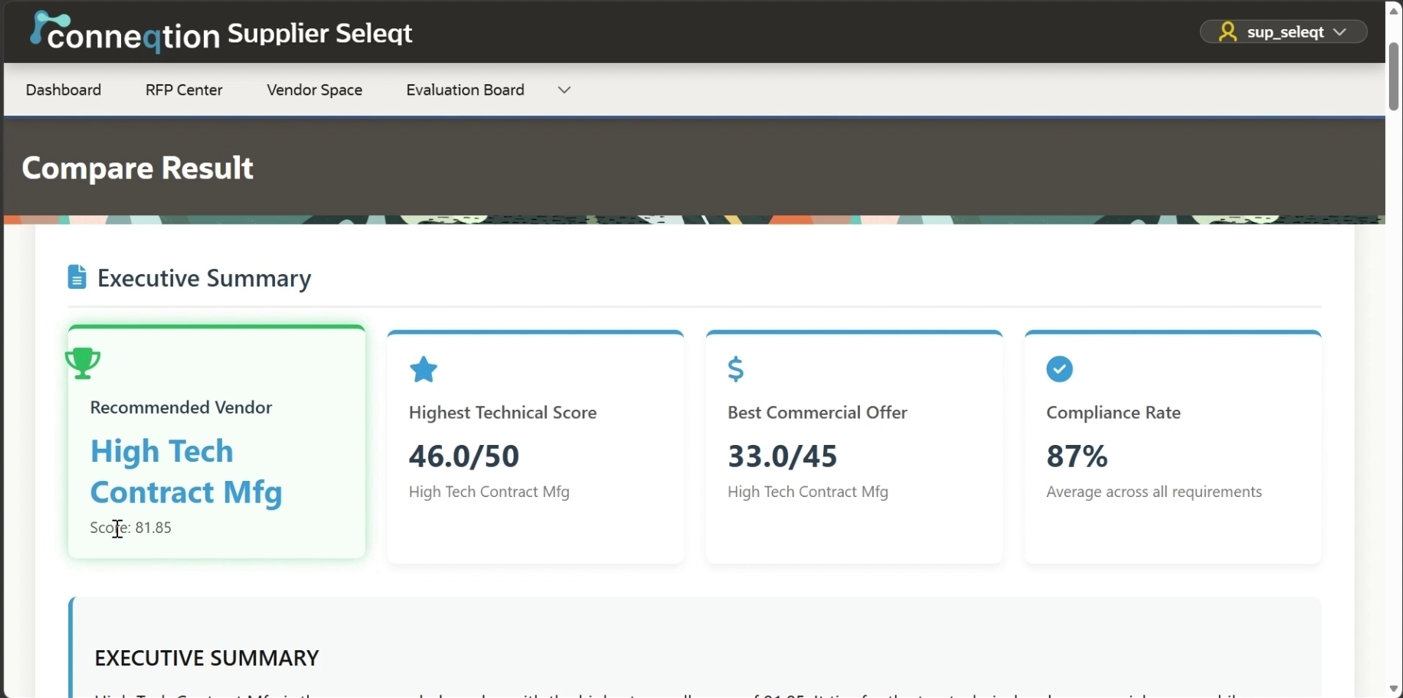 The Supplier Seleqt comparison report scores every bid on technical fit, commercial terms, and compliance, and names a recommended vendor.
Wanting a fuller picture before awarding, she opens the linked recommendation report. It runs a complete vendor comparison across all four suppliers who responded, scoring each one on technical requirements, commercial terms, and compliance. High Tech Contract Mfg comes out on top with the highest combined score, and the report explains exactly why, down to which line items and contract terms swung the recommendation in its favour. What would normally mean opening four separate quotations and comparing them manually is done for her in one view.
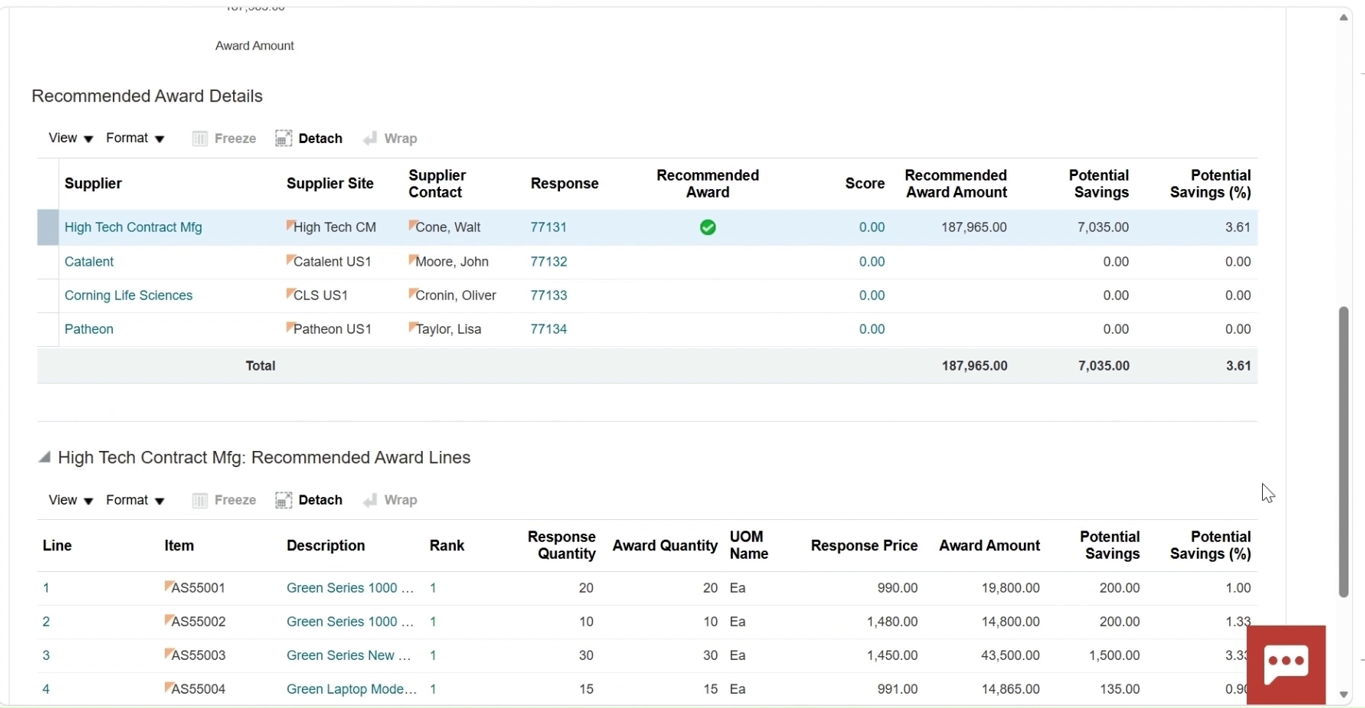 Back in the negotiation, applying the recommended award finalises High Tech Contract Mfg as the awarded supplier with a clear savings figure.
Satisfied with the recommendation, Zara goes back to the Command Center and applies the recommended award directly from the Priority Actions panel. The negotiation updates automatically: High Tech Contract Mfg is confirmed as the awarded supplier, the award amount is calculated, and the potential savings against the original budget are shown alongside it. A task that would normally involve several negotiation screens, a manual comparison, and a separate award entry is finished before her first meeting of the day.
Built on Oracle Technology
The Sourcing Command Center Agentic AI App is built using the following Oracle technologies:
- Oracle Fusion Cloud Procurement: the source of negotiation, RFQ, supplier response, and award data.
- Oracle Digital Assistant (ODA): powers the Ask Oracle natural language interface.
- OCI Generative AI: drives the insight generation, negotiation snapshots, and recommendation reasoning.
- Oracle APEX: supports the application layer, including the Supplier Seleqt evaluation and comparison module.
Conclusion
Sourcing does not slow down because procurement teams lack data. It slows down because that data is spread across negotiation screens, supplier responses, and spreadsheets, and every decision means pulling it back together by hand. The Sourcing Command Center is built to remove that friction. A category manager can open a single workspace, see what needs attention, get an explainable supplier recommendation, and apply the award, all without leaving the screen.
As an Oracle Fusion Agentic Applications partner, Conneqtion Group – A GenAI Innovations Awardee 2025 builds agentic apps that sit natively within an organisation’s existing Fusion investment. The Sourcing Command Center is one such addition, built to help sourcing teams move from reviewing data to making decisions.
If your Fusion Procurement is live and your sourcing team is still filtering, comparing, and switching screens to get to a decision, it is worth looking into the Sourcing Command Center by Conneqtion Group. Request a demo to see it applied to your own negotiations and supplier data.
Frequently Asked Questions
- Does the Sourcing Command Center replace Oracle Fusion Procurement negotiations?
No. It works on top of the negotiations and RFQ processes already running in Fusion Procurement. All the underlying negotiation, supplier, and award data stays in Fusion; the app simply makes that data easier to act on.
- Can a sourcing manager apply an award directly from the Command Center?
Yes. Once a recommendation is reviewed, awards such as a sole source award to the best overall response, or a maximum savings award split by line, can be applied directly from the Priority Actions panel, and the negotiation updates in Fusion automatically.
- Who is the Sourcing Command Center built for?
It is built for sourcing and category managers, procurement leaders, and anyone responsible for running negotiations and awarding suppliers inside Oracle Fusion Cloud Procurement, particularly teams managing a high volume of concurrent negotiations.