Most supplier compliance programs are reactive by design. A qualification lapses, an insurance certificate expires, or a required questionnaire goes unanswered, and nobody finds out until a sourcing event is already underway or an audit asks for evidence that was never chased down. The review work exists, the criteria exist, but nothing in the system actively tells a category manager which supplier needs attention first.
Oracle Fusion Cloud Procurement 26C rebuilds that process around prioritization instead of discovery. An AI agentic workspace watches supplier compliance and flags gaps as they appear. Assessment initiatives group individual qualifications into one measurable outcome per supplier. Eligibility scoring turns “is this supplier compliant” into a consolidated, gate-able answer rather than a judgment call spread across several disconnected records.
In this blog, we explore the five features in Oracle Supplier Qualification & Assessment 26C, spanning early AI-assisted qualification and the assess-and-score stage that follows, and what changes for category managers, compliance teams, and suppliers themselves.
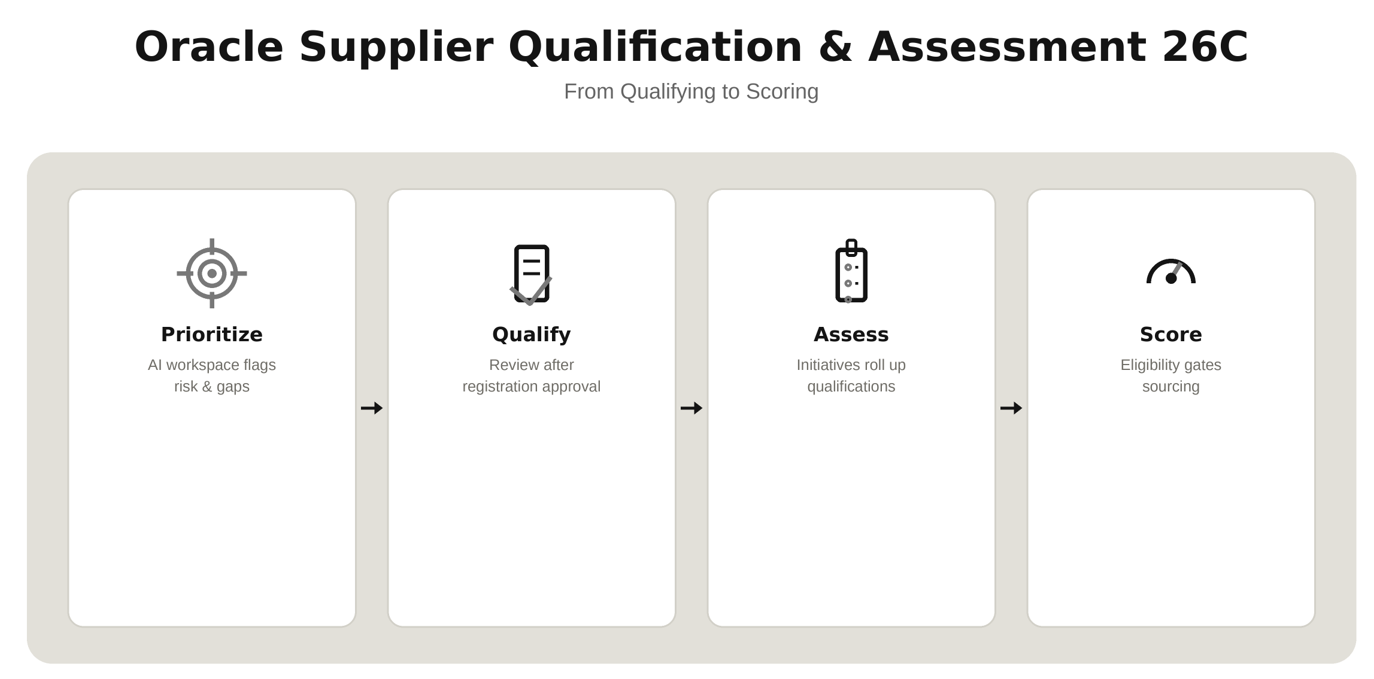
5 New Features of Oracle Supplier Qualification & Assessment 26C
- AI Agentic App: Supplier Qualification Workspace
This is the centerpiece of the release. A dedicated AI agentic workspace continuously monitors supplier compliance, flagging suppliers with adverse findings or missing qualifications instead of waiting for someone to notice during a periodic review.
- AI flags suppliers with adverse or missing qualifications as they occur, rather than surfacing them only during a scheduled audit.
- Suppliers are prioritized for follow-up by segmentation, so the riskiest or highest-spend suppliers rise to the top of the queue instead of being reviewed in whatever order they happen to appear.
- Category managers can launch qualification initiatives, place supplier sites on hold, and send reminders directly from the workspace, without switching between separate screens to take action.
The practical effect is that compliance monitoring stops depending on someone remembering to check. The workspace surfaces the problem and gives the category manager the tools to act on it in the same place.
- Qualify Suppliers After Spend Authorized Approval
26C separates two reviews that previously tended to blur together: the review that happens when a supplier registers, and the review that happens when a supplier is promoted toward being authorized to receive spend.
- Qualifications can now be created after registration approval, so compliance review begins before spend authorization rather than being treated as one combined step.
- This separates registration-based review, confirming the supplier is who they say they are, from promotion-related review, confirming the supplier meets the criteria to actually transact.
For organizations with a formal supplier tiering process, this gives compliance teams a natural checkpoint between “this supplier exists in our system” and “this supplier is cleared to do business with us,” instead of treating both as the same gate.
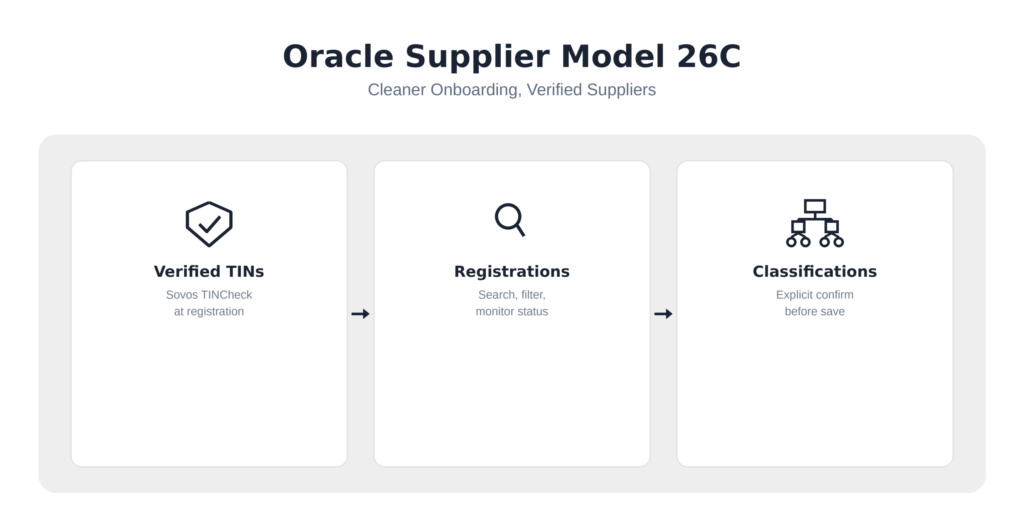
Also read – Oracle Supplier Model 26C: What’s New and What It Means for Businesses
- Create and Monitor Assessment Initiatives
Individual qualifications, insurance, certifications, diversity status, security questionnaires, have historically lived as separate records with no single view of how a supplier is doing overall. Assessment initiatives fix that by grouping multiple qualification areas into one measurable outcome.
- An assessment initiative groups several qualification areas together, rolling up individual qualifications into a single supplier-level outcome.
- Questionnaires can be sent and tracked directly as part of the initiative, rather than managed as a separate outreach process.
- Status is monitored at the initiative level, giving compliance teams one place to see how an entire cohort of suppliers is progressing instead of checking each qualification individually.
- Evaluate Assessments
Once assessments exist, someone must review them, and 26C gives that review its own dedicated Redwood experience.
- Assessments can be searched and drilled into directly in Redwood, rather than navigated through the underlying qualification records one at a time.
- Assessment data can be exported to Excel for offline review or reporting, which matters for compliance teams that need to document review evidence outside the application.
- The Requalify action lets a reviewer revise an assessment using the same qualification model it was originally built on, so a supplier does not have to be re-evaluated from scratch when only one qualification area has changed.
- Assess Supplier Eligibility
The last feature answers the question everything else in this release is building toward: is this supplier eligible to participate in sourcing.
- A consolidated eligibility view shows whether a supplier meets the compliance criteria required to participate in sourcing events, pulled together from their qualifications and assessments.
- Eligibility can be overridden per business unit, which matters for organizations where a supplier might be fully qualified for one region or business unit but not yet cleared for another.
This is what makes qualification and assessment operationally meaningful rather than just informational. Eligibility becomes something a sourcing event can check against, instead of a status that lives in a compliance team’s spreadsheet.
Conclusion
Oracle Supplier Qualification & Assessment 26C moves supplier compliance from something a team checks periodically to something the system actively manages. The AI agentic workspace catches gaps as they happen instead of waiting for a scheduled review. Assessment initiatives turn a scattering of individual qualifications into one measurable outcome per supplier. Eligibility scoring turns that outcome into a gate sourcing can enforce, down to the business unit level.
None of these five features work in isolation. The workspace feeds the initiatives, the initiatives feed the assessments, and the assessments feed the eligibility score that ultimately decides whether a supplier can participate in sourcing. Before rolling this out, it is worth mapping your current qualification criteria to the initiative and assessment structure 26C expects, since the value of eligibility scoring depends entirely on how well the underlying qualifications are organized.
Looking to turn supplier compliance into something measurable instead of something you chase?
Get in touch with us to plan your Oracle Supplier Qualification & Assessment 26C rollout.
Frequently Asked Questions
- What is the AI Agentic App for Supplier Qualification in 26C?
It is a dedicated workspace that continuously monitors supplier compliance, flags suppliers with adverse or missing qualifications, and prioritizes follow-up by segmentation. Category managers can launch qualification initiatives, place supplier sites on hold, and send reminders directly from the same workspace.
- Why does 26C separate qualification from registration approval?
Creating qualifications after registration approval lets compliance review begin before a supplier is authorized to receive spend, separating the check that confirms a supplier is legitimate from the check that confirms they meet the criteria to transact. This gives organizations a clearer checkpoint between the two.
- What does the Requalify action do when evaluate assessments?
Requalify lets a reviewer revise an existing assessment using the same qualification model it was originally built on. That means a supplier does not need to be evaluated from scratch when only one qualification area has changed, since the rest of the assessment can be revised in place.