It is the last week of the quarter. The finance team is closing the books. Thousands of ledger entries do not match. Someone has to find out why, fix the routine ones and send the unusual ones for approval.
Now picture a manufacturer planning next week’s outbound shipments. Hundreds of orders are waiting across several warehouses. Carrier capacity is tight and customer delivery dates are fixed. A planner has a day of comparing, checking and rebuilding ahead of them.
Both jobs are large. Both need judgment. Both also need exact calculations and strict rules. This is the kind of work Oracle built Fusion Claw for.
What is Oracle Fusion Claw?
Oracle announced Fusion Claw on 29 September 2026. Oracle describes it as a governed agentic execution runtime for Oracle Fusion Agentic Applications.
A runtime is the environment an application runs inside. Customers do not use Fusion Claw directly. They use the agentic apps built on top of it.
Earlier Fusion AI agents mostly helped people with single tasks. Fusion Claw is built to deliver a finished business outcome. That means larger, longer-running work such as deep research, computation, simulation, modeling and continuous re-planning. Oracle frames this as a shift from AI that assists to AI that executes.
Fusion Claw launched with 25 new Claw-powered applications across finance, HR, supply chain and sales. This took the Fusion Agentic Applications portfolio to 75 applications.
Where Fusion Claw sits in the Oracle Fusion stack
Fusion Claw is a new layer in the Fusion stack. It sits between the agent tooling above and the business applications below.
- Fusion Agentic Applications: the outcome-based apps that users work in.
- Oracle AI Agent Studio: the layer where agents and agentic apps are built and managed.
- Fusion Claw (new): the execution engine for the hardest, highest-value work.
- Fusion Applications: enterprise data, business objects, policies, approvals, permissions, processes, context and history.
Oracle shows Claw as its own runtime layer, not as a feature inside AI Agent Studio. Oracle has not said whether customers can configure Claw or build custom Claw apps. Those details are worth confirming with Oracle.
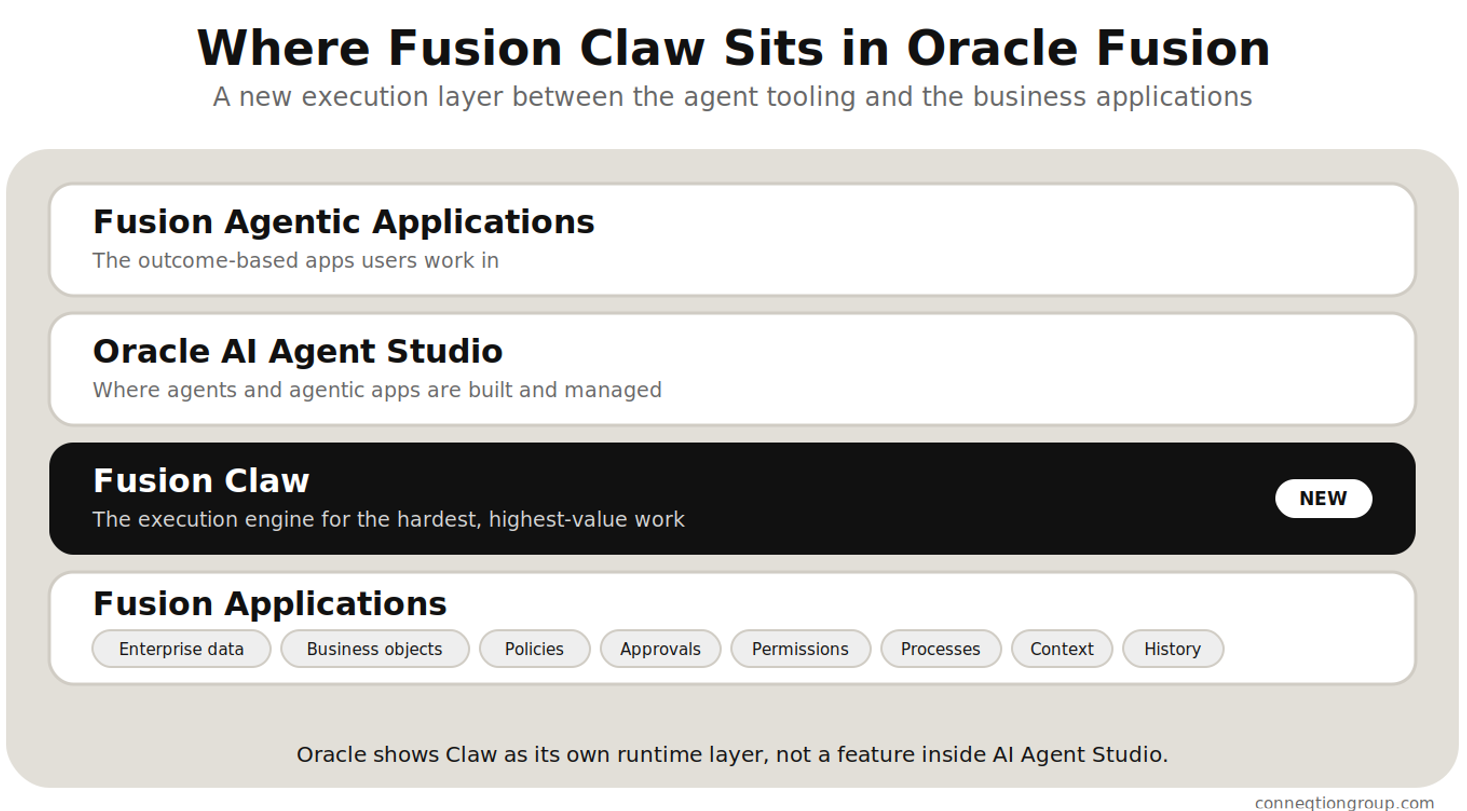 Diagram of the Oracle Fusion stack showing Fusion Claw as a new execution layer between Oracle AI Agent Studio and Fusion Applications
A simple analogy: the wedding planner
Think of a wedding planner. The planner thinks through the guest list, the schedule and the backup plans. The vendors deliver the food, flowers and music. The contract sets the limits on budget and scope. The checklist proves that everything was done.
Fusion Claw works in a similar way. The AI is the planner. Regular software is the vendors. The company rulebook is the contract. The record of the run is the checklist.
How Fusion Claw works: Think, Compute, Govern, Record
Each run follows four steps.
- A frontier AI model analyzes the request, reasons about it, weighs alternatives and creates a plan. It adapts when conditions change.
- Once the plan is ready, Fusion Claw hands the work to deterministic enterprise software. This is conventional code that gives the same precise result every time. It handles reconciliation, simulation, optimization, calculations and business rules.
- Governed actions and transactions run only with authorization.
- After the run, the full trail is kept for review.
One rule sits at the center of the design. The model can plan and recommend, but it never grants itself authority to act.
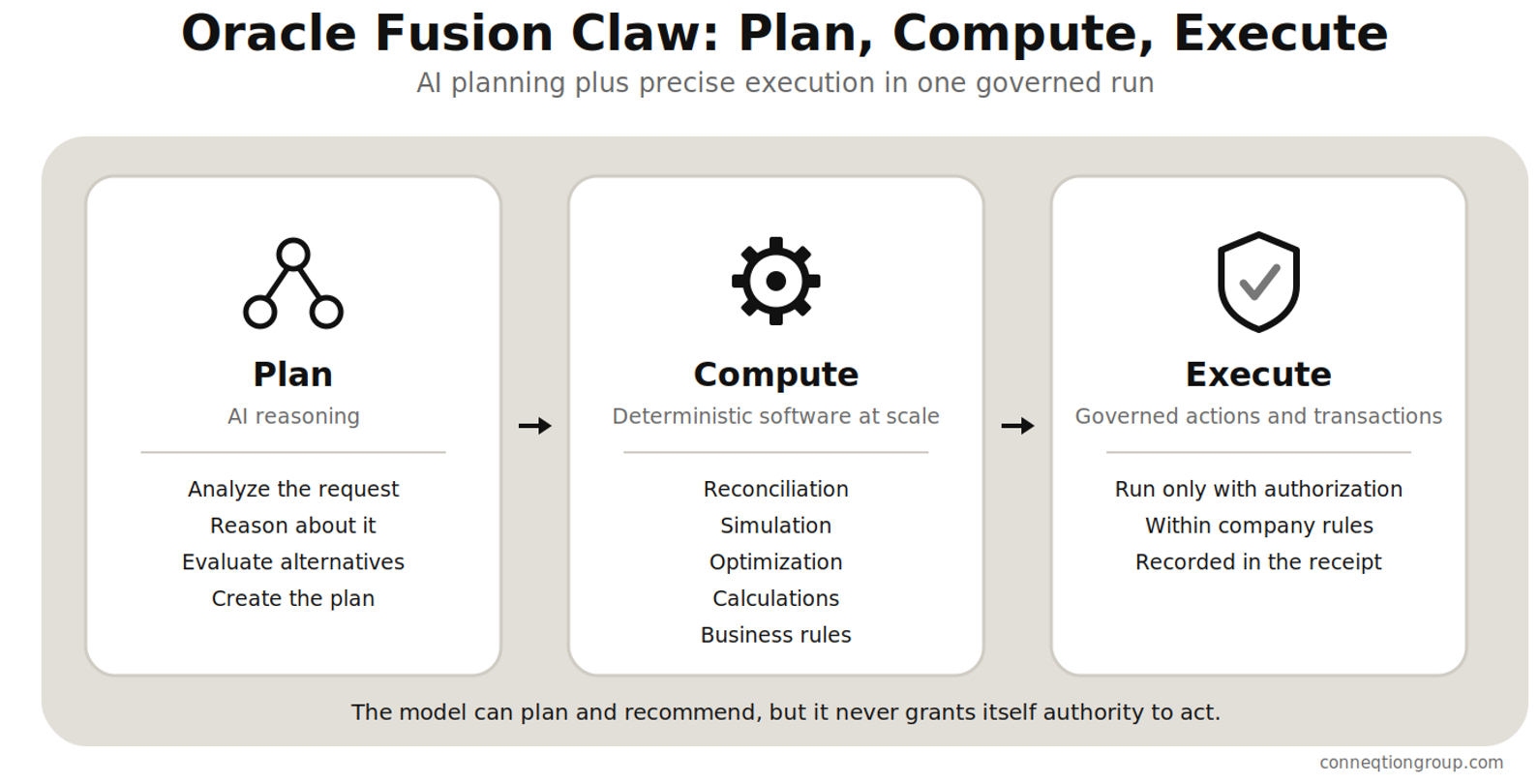 Diagram of a Fusion Claw run: Plan, Compute and Execute, with the model planning and deterministic software executing under authorization
Fusion Claw runs on Oracle Cloud Infrastructure. It uses frontier models including Google Gemini and OpenAI, with more models planned.
Why thinking is separated from doing
The split brings two benefits.
- Better accuracy. High-volume calculations and postings are never left to AI guesswork.
- Lower AI consumption. AI is used only where judgment is needed. Routine, repeatable work goes to regular software. Oracle presents this as a cost advantage. Savings have not yet been measured, so treat them as a claim to test.
The safety net: Envelope, Harness and Receipt
This is the part that CFOs, CIOs and auditors care about most. Fusion Claw uses three governance layers.
- Enterprise Operating Envelope (before the run). The rulebook. It captures objectives, procedures, policies, permissions, risk thresholds, decision rights, approval requirements and escalation limits.
- Outcome Trust Harness (during the run). The enforcer. It applies the envelope to every run and controls identity, capabilities, data access and actions.
- Outcome Receipt (after the run). The audit trail. It records the authority applied, the evidence used, the decisions made, the transactions executed and the final result.
Adjustable autonomy
Customers choose how much freedom each process gets. The range runs from quick assistance to governed full-auto execution, within authority the organization explicitly hands over.
Most teams are likely to start in assist mode on high-volume work, such as month-end close exceptions. They can then measure results and widen autonomy step by step as trust grows.
A real-world example: next week’s outbound shipments
This is a simplified example based on the Shipping Consolidation launch app. It is illustrative, not a customer result.
A manufacturing and distribution company has to plan next week’s outbound shipments. Hundreds of orders are waiting across several warehouses. Carrier capacity is limited, and some customers have firm delivery dates.
Before Fusion Claw
The logistics planner loses a full day. She pulls open orders and stock positions from Oracle Fusion SCM. She compares carrier options for timing, capacity and cost. She checks each customer’s service commitment, groups loads in a spreadsheet and keys the plan back into the system. A basic AI assistant can answer questions along the way, but she still does the thinking, the checking and the data entry.
With Fusion Claw
She gives one instruction: consolidate next week’s outbound shipments to lower cost without missing any delivery commitment. Four things then happen.
- The rulebook is already in place. The company has loaded its rules into the Operating Envelope. These include carrier and load capacity limits, a spending limit per shipment plan and the service commitment for each customer. One key rule says that any plan that would miss a customer delivery commitment cannot be applied automatically and must go to a human.
- The AI does the thinking. It reviews the open orders and works out which shipments can be combined. It lists the options, such as holding an order for a fuller load, using a faster carrier or splitting a load. If a carrier cancels a slot, it re-plans.
- Regular software does the heavy lifting. Comparing hundreds of combinations of orders, loads and carriers against timing, capacity and cost, then posting the approved plan into Fusion, is handled by standard, precise code rather than AI.
- The rules decide who signs off. Suppose the cheapest plan would deliver one order a day late. That breaks the service rule, so Claw does not apply it. It sends the plan to the planner with options. Everything that passed the rules goes ahead automatically.
When the run ends, Claw produces an Outcome Receipt. It shows which rules were applied, what data was used, why each decision was made and which shipment plans were posted. If a customer or an auditor later asks why an order moved to a different carrier, the answer is already on record.
The same pattern in finance
Before month-end close, the AI investigates mismatched ledger entries. Standard code reconciles the thousands of routine entries. Anything above a set amount goes to the controller for approval. The Ledger application, one of the launch apps, follows this pattern.
Launch applications worth knowing
- Ledger: reconciles large volumes of accounting entries and investigates exceptions ahead of close.
- Shipping Consolidation: compares options on timing, capacity, cost and service commitments, then executes the best plan once authorized.
- Workforce Staffing: applies the same approach to HR scheduling.
- Account Territory Growth Plan: applies it to sales coverage planning.
These apps sit within Oracle AI Agent Studio for Fusion Applications. Organizations can build and manage agentic applications there, with built-in monitoring, ROI measurement and safety controls.
How is this different from existing agentic apps?
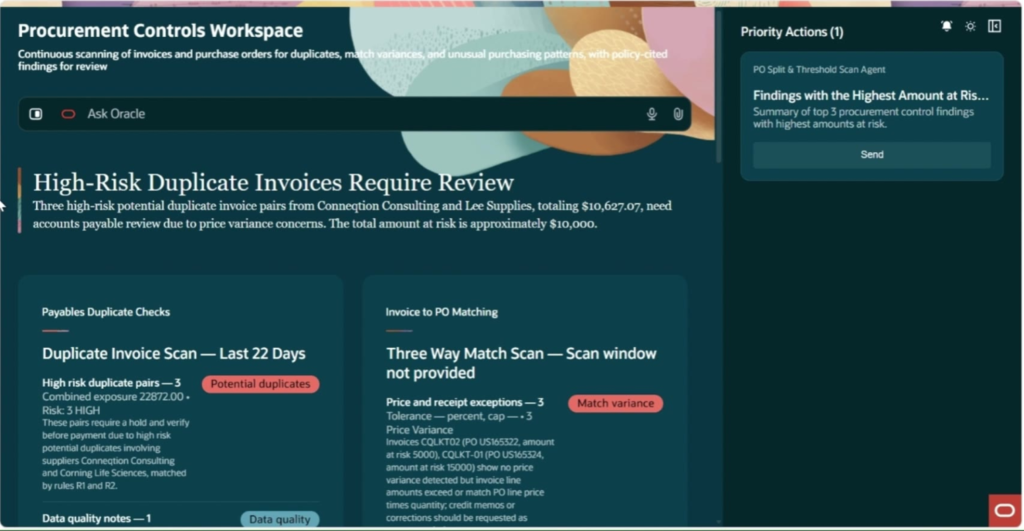
Both kinds of apps think and decide. The difference is the size and shape of the job. Existing Fusion agentic apps suit everyday task flow. Claw-powered apps suit big, analysis-heavy jobs that involve heavy computation and many rules. Conneqtion has covered several agentic apps already, including Sourcing Command Center, Procurement Transaction Intelligence and Best Fit Candidate for Oracle Fusion HCM.
Conclusion:
Oracle Fusion Claw moves agentic AI in Oracle Fusion from helping with single tasks to finishing large, rule-bound jobs. The AI plans the work. Deterministic software handles the calculations and postings. The Envelope, Harness and Receipt keep every run inside company rules and leave a record of what happened.
These pieces depend on each other. The plan is only as safe as the rules it runs under, and the rules only work if they are written down. Before adopting Claw-powered apps, it is worth documenting current approval rules, decision rights and escalation limits. Starting in assist mode on one high-volume process, then widening autonomy step by step, gives teams room to build trust. Pricing, licensing and regional availability are still emerging, so confirm current terms with Oracle first.
Looking to move your finance, supply chain or HR processes from assisted to governed execution?
Get in touch with us to plan your Oracle Fusion Claw and agentic apps journey.
Frequently Asked Questions (FAQs)
1. Is Fusion Claw a Fusion capability or an OCI service?
Fusion Claw is a Fusion capability that runs on Oracle Cloud Infrastructure. It is available to Oracle Fusion customers only.
2. What about cost and availability?
Pricing, licensing and regional availability are still emerging, including for GCC and India. Organizations should confirm current terms with Oracle before planning a rollout.
3. Who benefits first?
Companies with clearly documented processes and approval rules are best placed. The Operating Envelope can only enforce rules that exist in writing. Teams with clear, current policies, decision rights and escalation limits can move to higher levels of automation faster. Teams without them often need to document their processes first.