Procurement teams are expected to notice challenges before they become losses: the duplicate invoice that slips through, the purchase order quietly split to avoid an approval limit, the supplier bank account that changes days before a payment run. Oracle Fusion Procurement and Payables hold all the evidence needed to catch these issues. The problem is that no one has the time to go looking for it.
Reviewing invoices against purchase orders, checking suppliers for split POs, and scanning payment history for diversion risk are all manual, screen-by-screen exercises today. A controller or procurement compliance lead must open individual invoices, cross-reference PO schedules, pull up supplier bank records, and do the arithmetic themselves. By the time a pattern is spotted, the payment may already be out the door.
Procurement Data Sits Idle Without Continuous Review
Most organizations running Oracle Fusion Procurement and Payables already capture everything an investigation would need: invoice numbers, amounts, PO references, receipt quantities, supplier bank details, negotiation records. On paper, the controls exist. In practice, nobody is scanning that data continuously.
Asking “do we have any duplicate invoices this month?” or “has any purchase order been split to stay under the approval threshold?” means running multiple saved searches, exporting to a spreadsheet, and manually comparing rows. Checking whether an invoice truly matches its purchase order on price, quantity, and tax means opening the invoice, the PO, and the receipt side by side. The data is sitting in Fusion, secure and complete, but turning it into an answer is still entirely on the reviewer.
How the Procurement Transaction Intelligence Agentic AI App Works as a Compliance Co-Pilot
The Procurement Transaction Intelligence app is built on Oracle Fusion Procurement and Payables and continuously scans invoices and purchase orders for duplicates, three-way match variances, and unusual purchasing patterns, surfacing policy-cited findings for review. Rather than a reviewer working through transactions one by one, a set of AI agents evaluates the underlying data against defined detection rules and policy thresholds, then explains exactly why a finding was raised and what it would cost if left unresolved.
This brings duplicate invoice checks, invoice-to-PO matching, PO split and threshold monitoring, payment diversion checks, and sourcing integrity checks into a single workspace, inside the environment the procurement and AP teams already use.
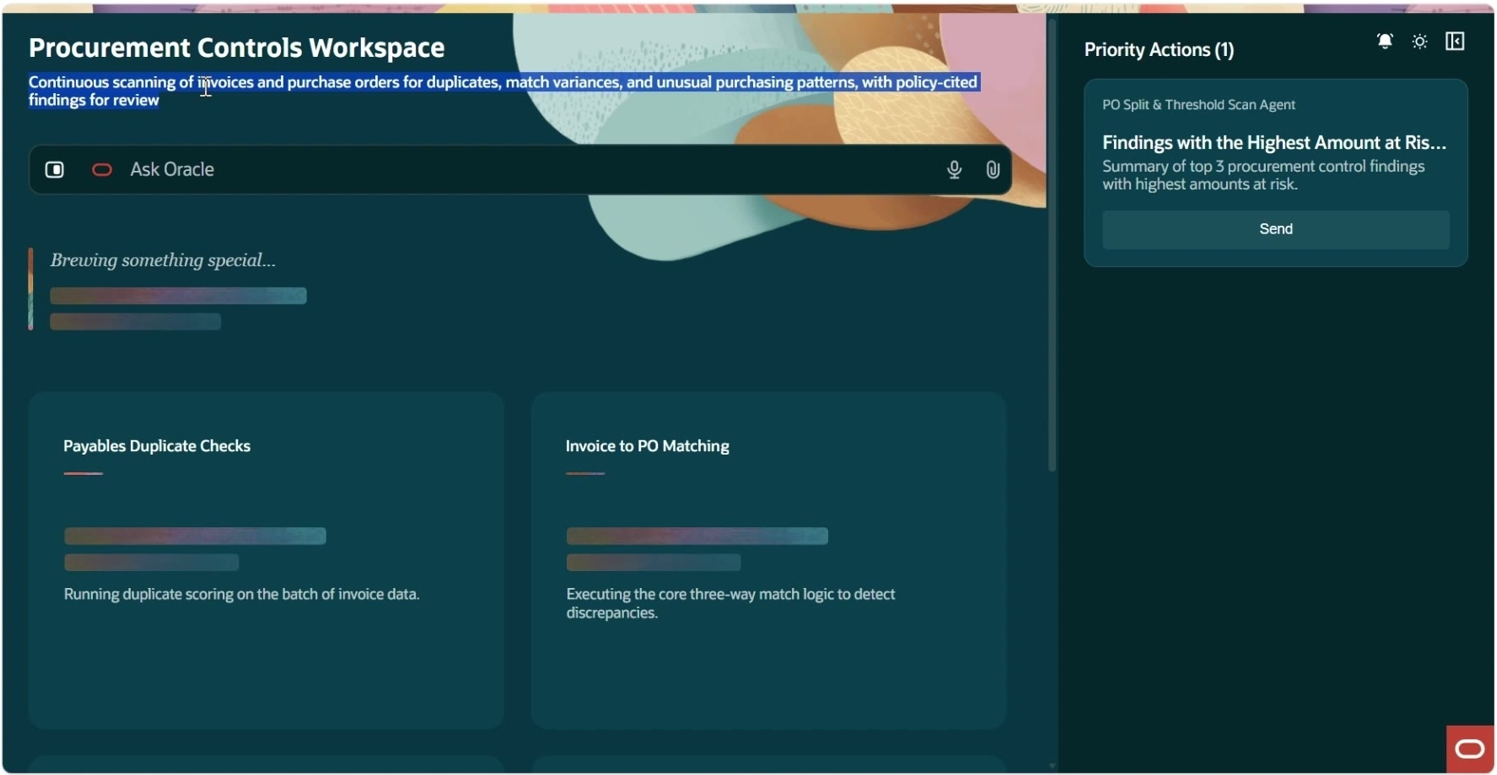 The Procurement Controls Workspace opens with continuous scanning already underway across invoices and purchase orders.
Key Features of the Procurement Transaction Intelligence App
- Insights: The workspace opens with a plain-language summary of what needs attention, such as high-risk duplicate invoice pairs and their total exposure, generated by the AI agents working in the background rather than compiled by a reviewer.
- Payables Duplicate Checks: A continuous duplicate invoice scan compares invoice number, supplier, date, and amount across recent transactions, flags high-risk pairs, and separates them from low-value data-quality noise such as zero-amount invoices.
- Invoice to PO Matching: The core three-way match logic compares invoice lines against purchase order price, quantity, and receipt data, surfacing price variances and over-PO variances with the exact percentage and amount at risk for each exception.
- PO Split and Threshold Monitoring: A purchase order fraud pattern scan checks whether purchase orders raised by the same buyer for the same supplier are being kept just under the approval threshold, or split across multiple POs to avoid it, and reports the combined exposure.
- Bank Account Change Detection: A payment diversion scan reviews supplier bank record changes against the scheduled payment run, checking for shared accounts or last-minute detail changes that could indicate diversion risk.
- Sourcing & Tendering Integrity: A procurement policy compliance check reviews negotiation and sourcing records for single-bid awards and split tenders that may have been structured to bypass competitive bidding policy.
- Ask Oracle Bar: Any of these checks can be triggered in plain English, for example asking for potential duplicate invoices in the last 30 days. The orchestrator routes the request to the right agent and returns a structured answer, without the reviewer building a filter or a saved search.
- Direct Action, Not Just a Report: Findings are not just displayed, they can be acted on immediately, placing an invoice on hold, requesting a credit memo, sending an exception to procurement, or emailing a findings summary, all from within the same screen.
Workflow of the Application: A Day in the Life of a Procurement Controls Reviewer
The easiest way to understand the Procurement Transaction Intelligence app is to follow a reviewer through it. Meet Liam, a buyer and procurement controls reviewer who needs to know, every morning, whether anything in the last few weeks of invoices and purchase orders needs attention.
A workspace that opens with the risk already summarised
When Liam logs in, the workspace does not ask him to run a search. It opens with a headline finding already prepared: three high-risk potential duplicate invoice pairs from two suppliers, totaling just over $10,600, need accounts payable review due to price variance concerns.
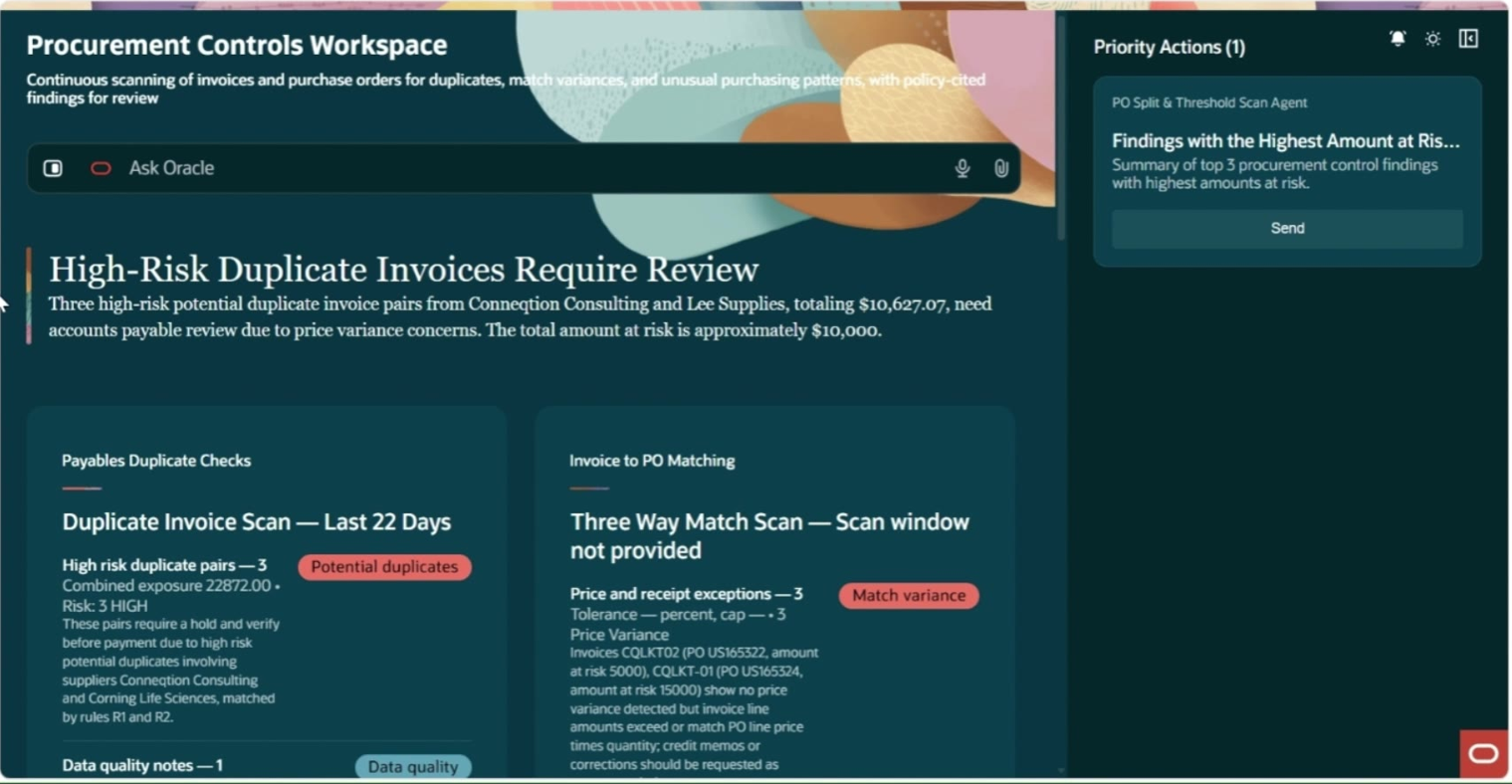 The workspace leads with the highest-risk finding, backed by the Payables Duplicate Checks and Invoice to PO Matching scans.
He drills into the duplicate invoice detail
From the summary card, Liam opens the full duplicate invoice review. Every potential duplicate pair is listed with both invoice numbers, the supplier, the invoice dates, the amount, and a plain-language reason, for example two invoice numbers that resolve to the same number once formatting is stripped, submitted for the same supplier and identical amount.
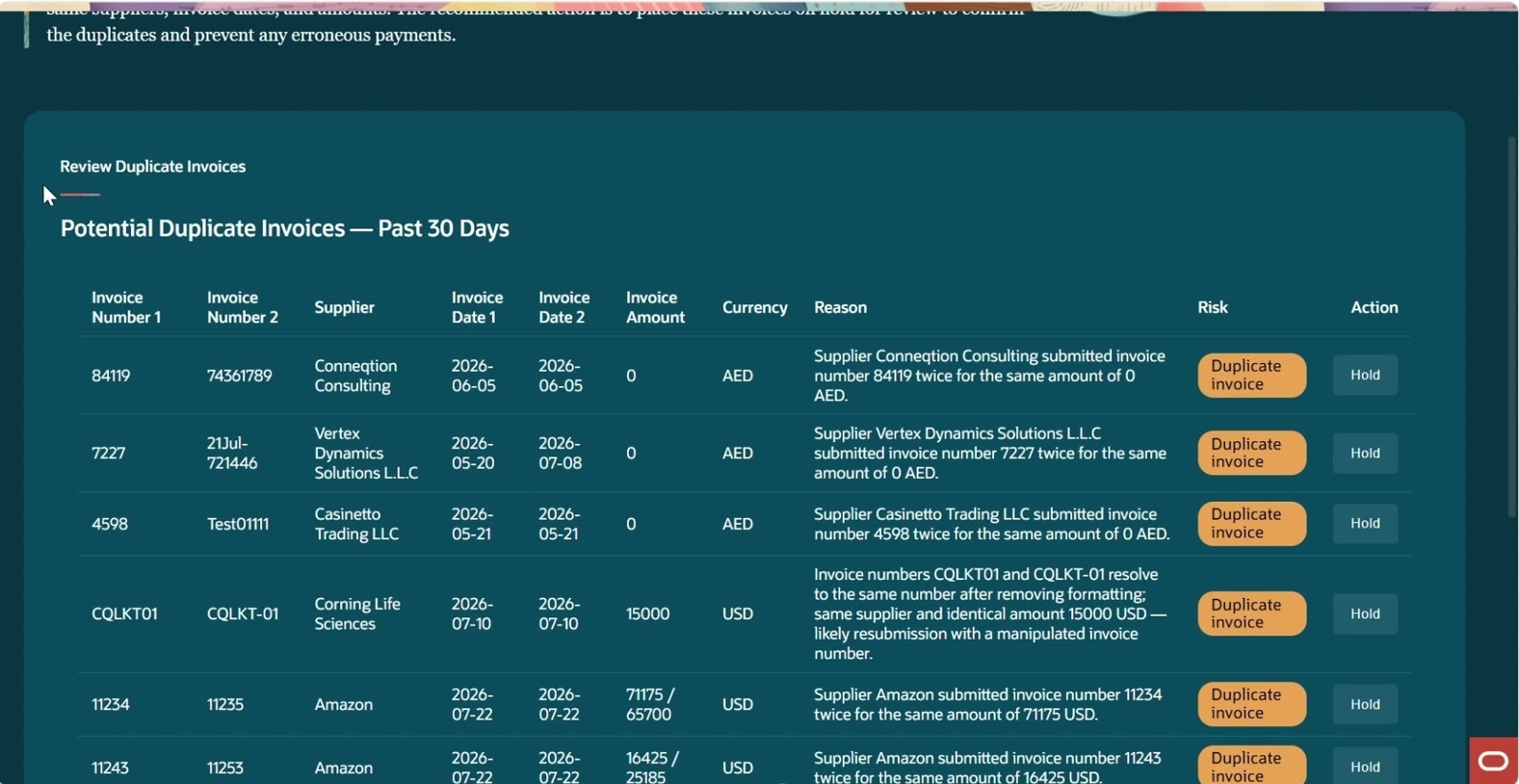 Each potential duplicate pair carries its own reasoning and a one-click Hold action.
One click places a real hold in Fusion
This is where the app moves beyond reporting. Selecting Hold against invoice CQLKT-01 does not just flag it in the app, it creates an actual invoice hold in Oracle Fusion Payables, with a hold ID, a hold reason of Duplicate Invoice, and the reviewer’s name and timestamp recorded against it.
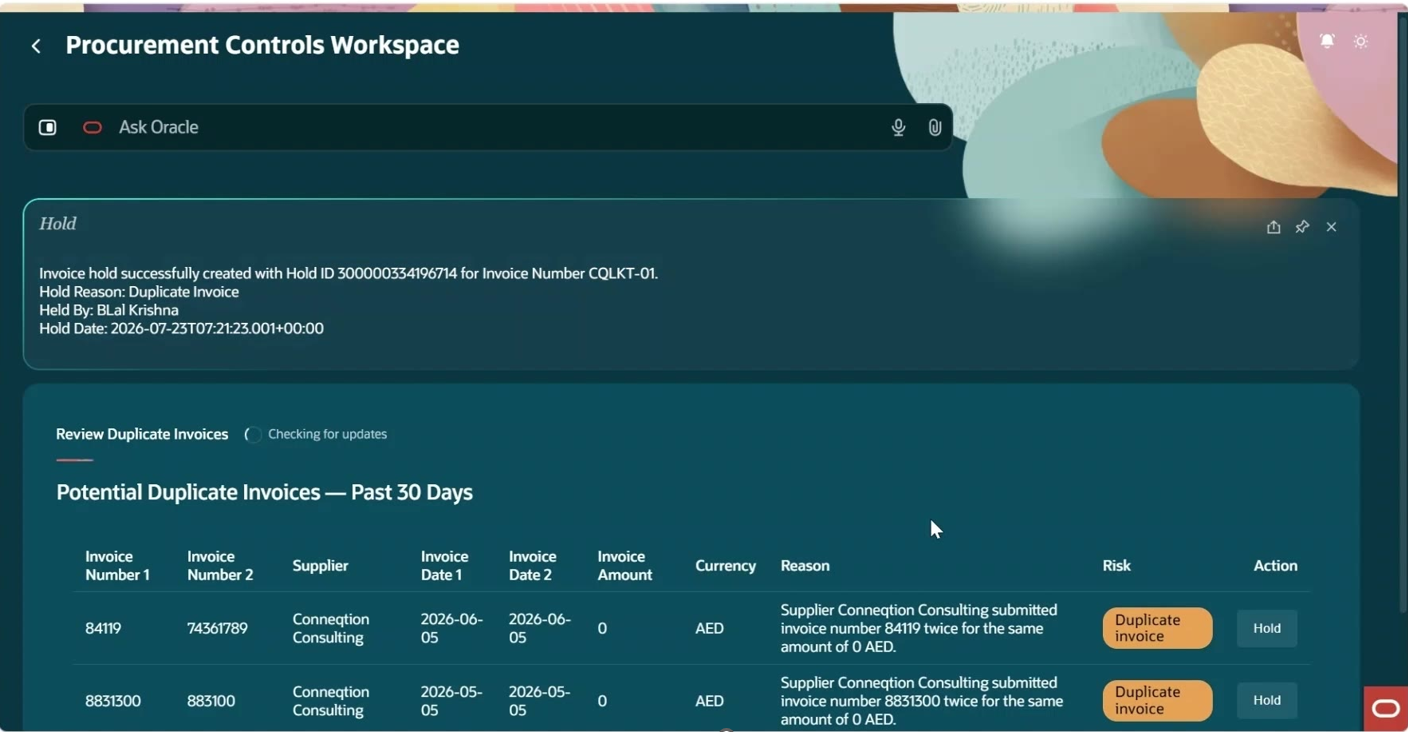
The hold is written straight back into Fusion Payables, not just logged inside the app.
The three-way match agent finds what a manual check would miss
Turning to Invoice to PO Matching, the app has already compared invoice CQLKT01 against its purchase order and flagged an over-PO variance. The exception detail shows the invoiced quantity, unit price, schedule price, PO reference, buyer, and the exact variance percentage and amount at risk, with a recommended action to request a credit memo.
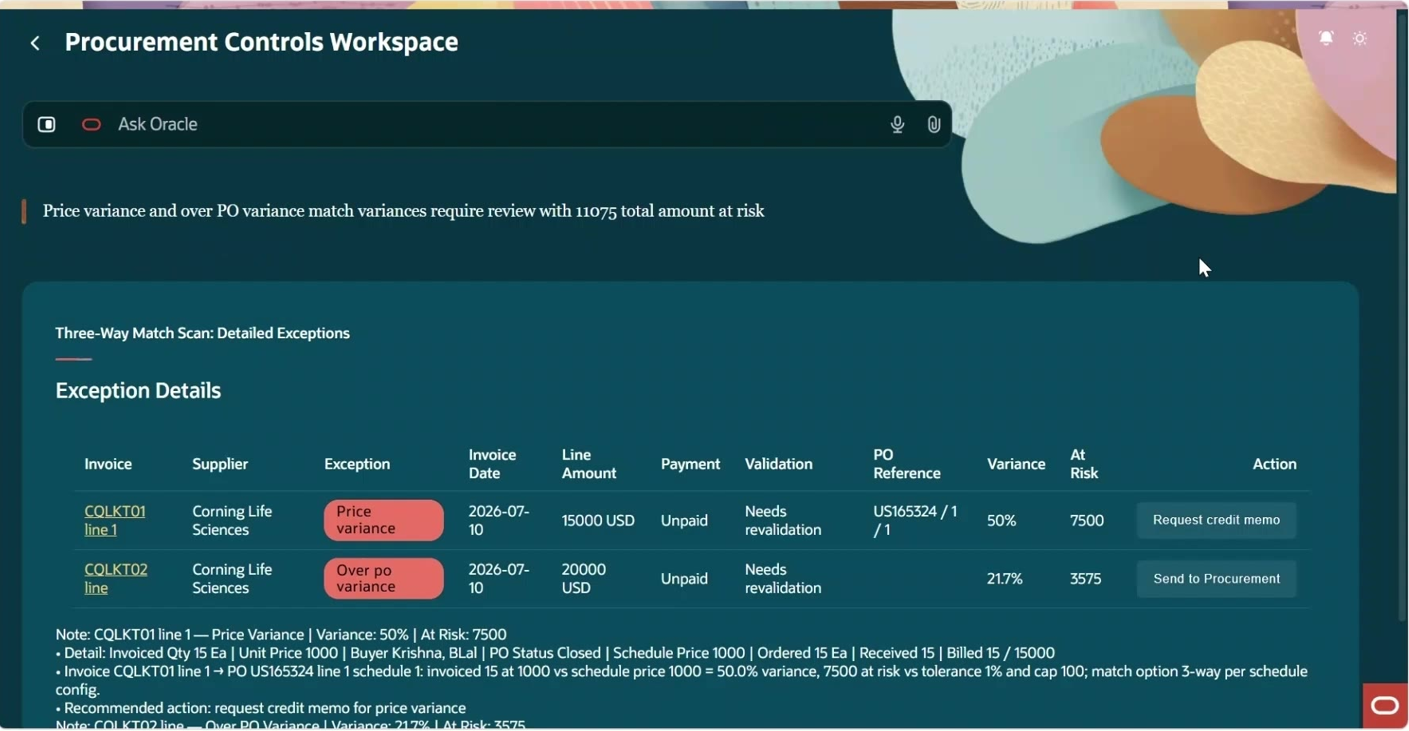 Price and over-PO variances are quantified line by line, with a recommended next action for each.
Opening a single exception goes one level deeper still, showing the invoice-to-PO comparison in full: invoiced quantity against PO schedule price, the calculated variance percentage against the configured tolerance, and buttons to hold the invoice or send it straight to procurement.
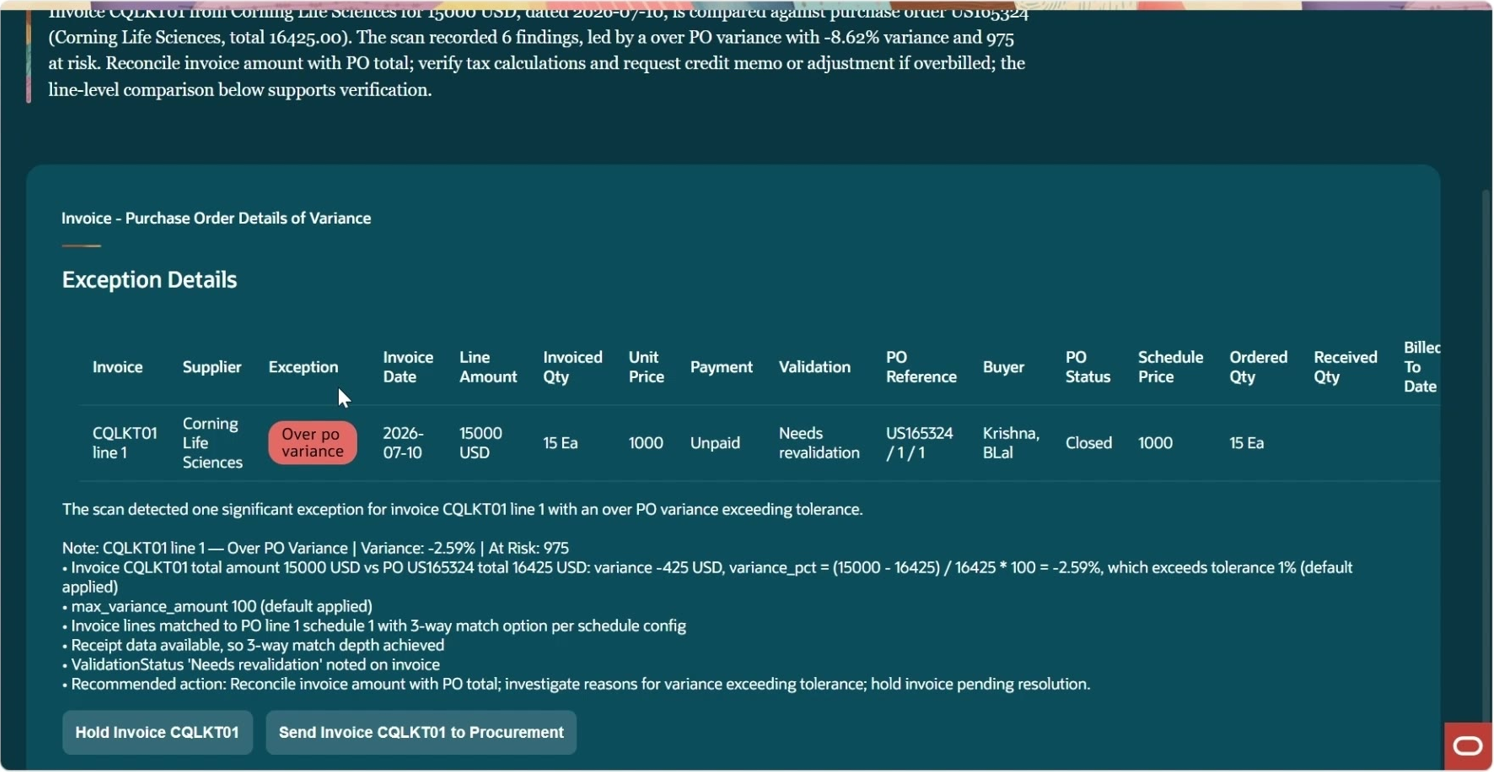 A single exception drills all the way down to the line-level math behind the variance.
PO splitting and payment diversion get the same scrutiny
The same workspace continuously runs a purchase order fraud pattern scan and a payment diversion scan. In this case, the PO split scan has identified purchase orders from the same buyer and supplier that individually sit under the approval threshold but combine well past it, while the payment diversion scan confirms no suspicious bank account changes were found across supplier records in the last 100 days.
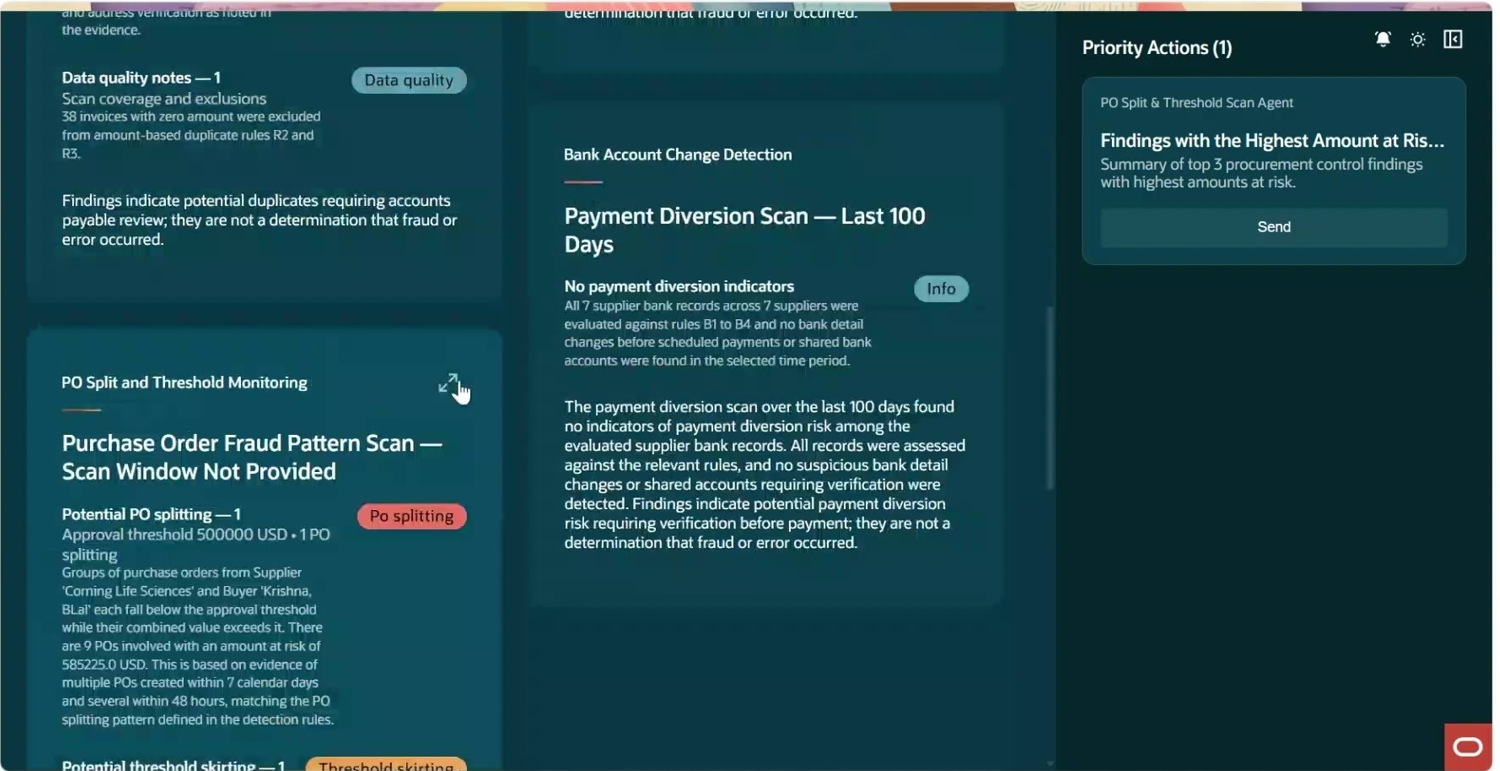 PO splitting risk and payment diversion risk are monitored side by side, each with its own evidence trail.
A findings summary ready to send, not just to read
When several findings need to go to a wider audience, Liam does not need to copy details manually. The app drafts findings email summarising the highest-risk items, in this case potential PO splitting and threshold skirting, complete with the PO references, risk level, and amount at risk for each, ready to review and send.
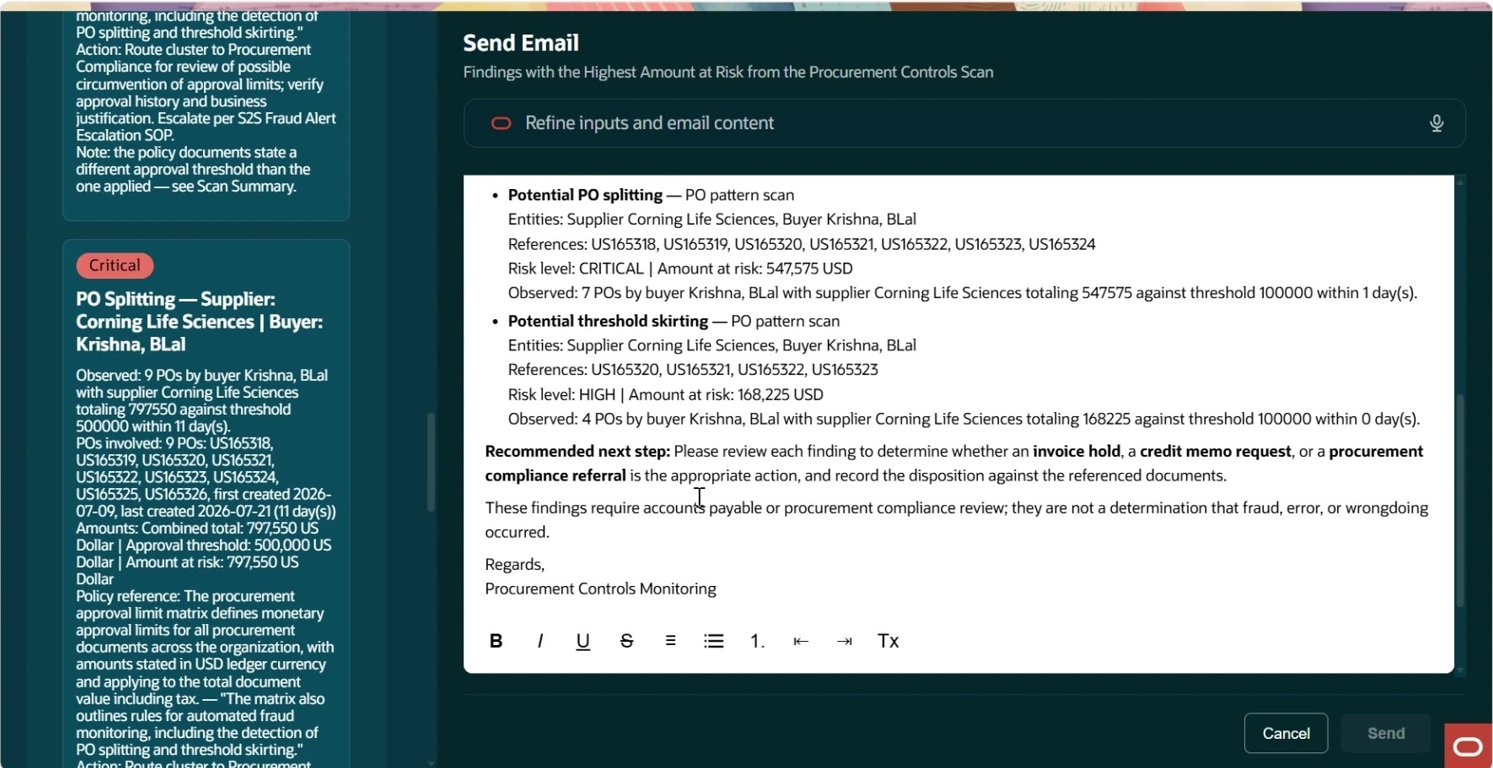 A findings summary drafts itself from the scan results, ready for Liam to review and send on.
Sourcing integrity checked in the background
Alongside invoice and PO monitoring, a procurement policy compliance check continuously reviews negotiation records for single-bid awards or split tenders. Where nothing is flagged, the app says so plainly, so liam knows sourcing integrity was checked, not skipped.
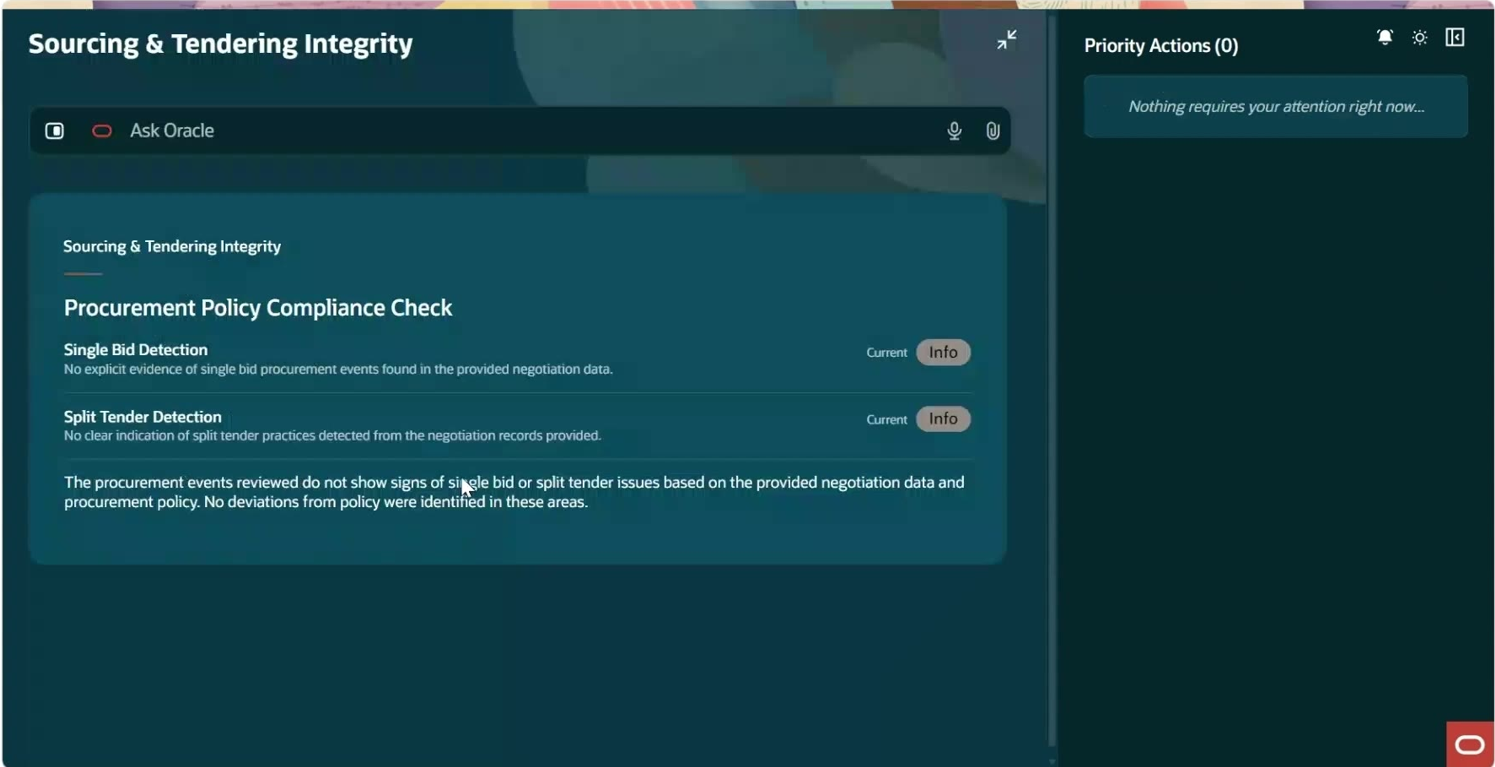 Even a clean result is reported explicitly, with the policy basis for the check stated.
Every finding traces back to a real Fusion record
Nothing in the workspace is invented. Every flagged purchase order, like US165318 between buyer Liam and supplier Corning Life Sciences, can be opened directly in the native Oracle Fusion Procurement screen to see the underlying order, supplier, amount, and status.
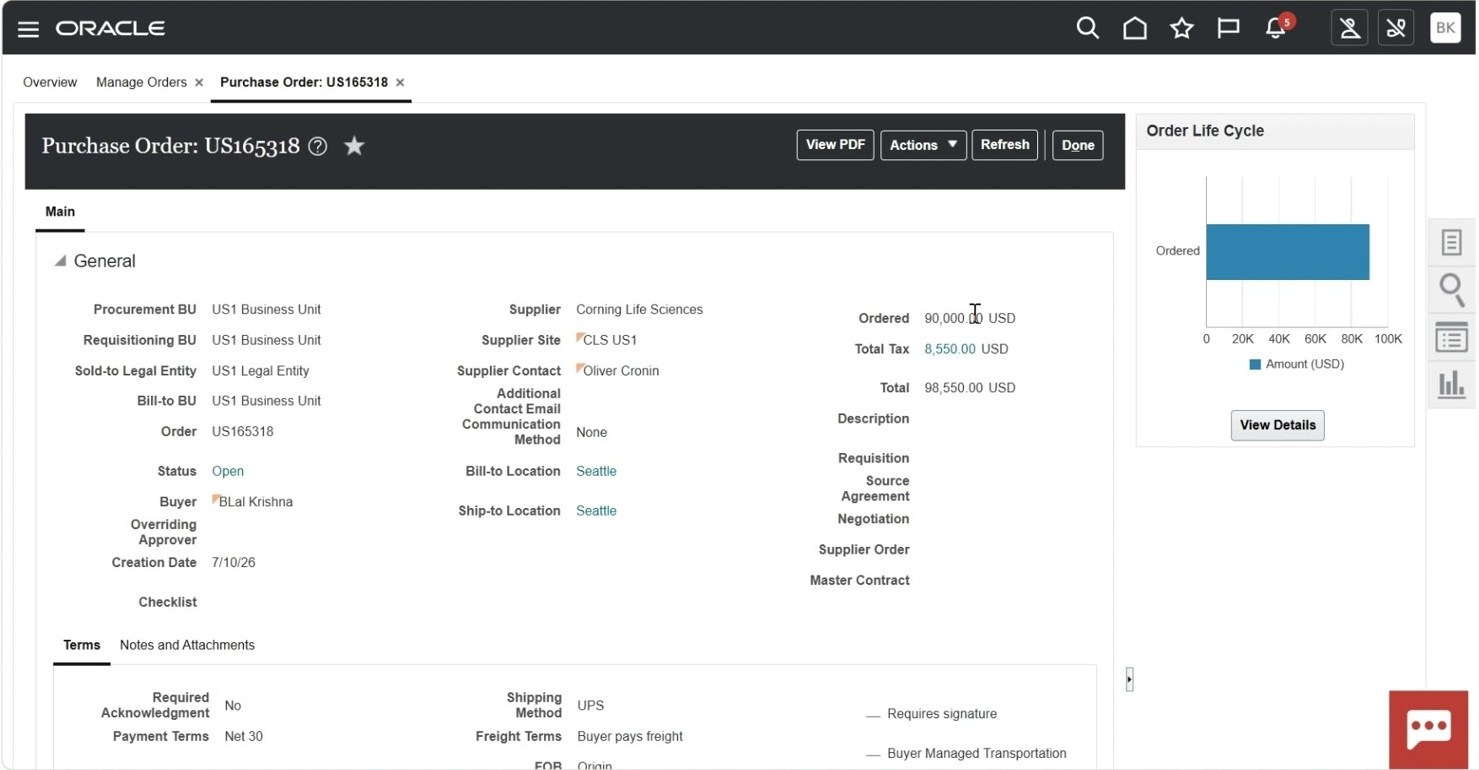 Every finding is traceable back to the source purchase order or invoice inside Fusion.
What used to take a manual cross-check across invoices, purchase orders, receipts, and supplier bank records is now a continuously running scan, with plain-language reasoning, quantified risk, and a direct path to action, all on one screen.
Built on Oracle Technology
The Procurement Transaction Intelligence app is built using the following Oracle technologies:
- Fusion Procurement and Payables: The source of invoice, purchase order, receipt, and supplier bank data.
- Oracle Digital Assistant (ODA): Enables the natural language Ask Oracle interface.
- OCI Generative AI: Powers the duplicate detection, match variance analysis, and fraud pattern reasoning.
- Oracle APEX: Supports the application layer and write-back actions such as invoice holds.
Conclusion
Procurement fraud and compliance gaps rarely come from a single dramatic event. They come from small, repeated patterns, a duplicate invoice here, a split purchase order there, a bank account changed just before a payment run, sitting unnoticed because nobody has the time to check every transaction against every rule. The Procurement Transaction Intelligence app is built to close that gap. It scans continuously, explains every finding in plain language with the policy or calculation behind it, and lets a reviewer act immediately, on the same screen, without leaving Fusion.
As an Oracle Fusion Agentic Applications partner, Conneqtion Group designs agentic apps that sit natively within an organisation’s existing Fusion investment. The Procurement Transaction Intelligence app is one such addition, built to bring continuous fraud and compliance monitoring to procurement and accounts payable teams.
If your Fusion Procurement and Payables are live and your team is still manually cross-checking invoices, purchase orders, and supplier records, it is worth looking into the Procurement Transaction Intelligence app by Conneqtion Group.
If you would like to see how the app works within your Fusion environment, Conneqtion Group can walk you through a demo of its features, including the Ask Oracle bar, the duplicate and match variance scans, and the invoice hold action. Request a demo to see it applied to your own transaction data.
Frequently Asked Questions (FAQs)
- How is this different from the standard duplicate invoice checks already in Oracle Fusion Payables?
Standard checks typically catch exact duplicate invoice numbers at entry. The Procurement Transaction Intelligence app goes further, catching near-duplicates such as reformatted invoice numbers, explaining the reasoning behind each match, quantifying the amount at risk, and allowing the reviewer to place a hold directly from the finding.
- Does this app require any system in addition to Oracle Fusion Procurement and Payables?
No additional core system is required. The app is built on Fusion Procurement and Payables and uses Oracle technologies already part of the Oracle ecosystem, including ODA, OCI Generative AI, and APEX. If Fusion Procurement and Payables are already live, the app works within that existing environment.
- Can actions taken in the app, such as an invoice hold, be seen in native Oracle Fusion screens?
Yes. Actions like placing an invoice on hold are written back into Fusion Payables directly, with a hold ID, reason, and reviewer name recorded, so they appear in the native invoice record and are not limited to the app itself.